Teaching Reading from Day 1 – Sight Words

teaching reading series

Looking for last week’s post from this series?

What are sight words?  They are words that we just know to look at them.  And we know what they mean without thinking.  Right now, as an adult, your sight word vocabulary is probably in the thousands of words.  Maybe even hundred thousands.  And, they are based around your specialty.  If you are a scientist, or in the medical profession, you have hundreds of sight words in your vocabulary that would be words I would have to sound out using phonics or other reading techniques, and I’d have to look up in a dictionary.  If you are an engineer or mathematician, you have a different set of sight word vocabulary.  And lawyers, well, that’s a whole other set.  I love to cook and bake, so my sight word set includes words like rigatoni and fusilli, parboil and blanche.

But as a child, we start as a blank slate.  And there are basic sight words that can’t be sounded out phoneme by phoneme (fo-neem = sound by sound).  And there are words like the word phoneme that don’t sound like they look.  We have to be taught at some point that p and h together say /f/.  So where do you start?  Obviously singing the alphabet with your child is awesome.  But beyond that, you can begin working on letter sounds with your child.  (I’ll do a whole other post on teaching letters and sounds, I promise.)  And you can start introducing the basic sight words they’ll need to know.  You can usually find some little picture cards with words on them at Dollar Tree.  They’ll have a picture of a cat and the word “cat” on the card.  These are fabulous.  You can write words on index cards like “tv,” “couch,” “fireplace,” and “fish tank” to post on those items around your house (if you chose to do this… I personally don’t like labeling my whole world.  Some moms love this idea, which is why I shared it.)

You can also find a great set of what are determined by professionals (Dolch and Fry are the most common) to be sight words in flashcard form here.  Different schools use different lists.  But if you are working with your child ahead, then any list you work on is fabulous.  The more words your child can become accustomed to, the better.Snip20141022_11

Am I saying you should drill your three and four year olds with flash cards to prepare them for kindergarten?  NO!  But these “flashcards” are a fabulous way to keep the words present in your child’s mind.  Perhaps you post a couple of them random places in your home – maybe one on the refrigerator door with some magnets so your child can build the word occasionally.  Perhaps on the mirror where he or she brushes her teeth.   Maybe put one on the garage door, and read it as you go out to the car.  Or maybe you want to get really fun and build words with “skeleton bones” – check out this super fun word building idea from Jamie over at Hands On As We Grow.  You can easily put three – five sight word cards on a tray with the “skeleton bones” and let your child practice building the words.  Nothing says you have to take these cards and hang them on a “word wall” alphabetically.  But you could.  Totally up to you and how interactive you want to be with them – remembering that the more FUN interaction your child has with a word, the more likely it is to become a member of your child’s sight word vocabulary.

You can also use them with your older child to begin basic alphabetizing skills – presort the cards so that there’s only one word that starts with each letter, then add more in as their skills increase.

Come back next Friday as we explore a different kind of sight words – called “Environmental Print.”
Kids in the Kitchen – Banana Bread

kids in the kitchen

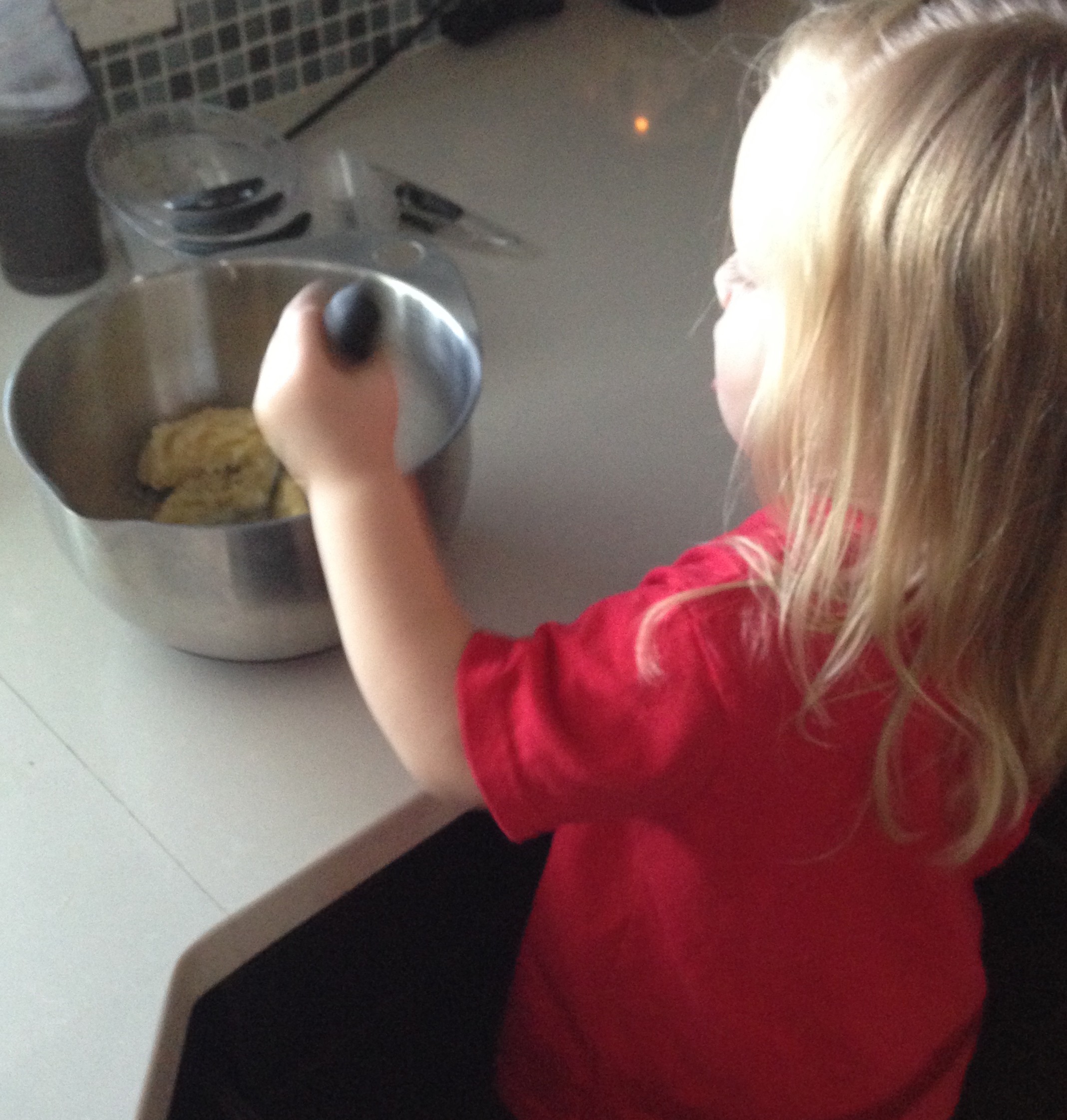
I love making banana bread.  But I love eating it even more.  Everybody makes theirs a little different, but this time I made mine very different… didn’t change a single ingredient… I just changed the physical part of HOW it was made.  Because I had help!  Becca loved getting to mash the bananas, loved dumping the ingredients into the bowls and stirring, and she loved watching the mixer beater go around and around and around!  This time we also added in some additional math – because we doubled the recipe.  So we mashed our bananas, measured them, and then saw that we had enough bananas for a double recipe.  So I had Becca help me add the whole numbers together to figure out how many scoops of each item we would need.  Baking is always such a fun and easy way to sneak a math lesson in!

IMG_0038IMG_0040Here’s our recipe:

Banana Bread
2 1/4 cups flour
2 1/4 tsp baking powder
3/4 tsp Kosher salt
3/4 cup shortening
1 1/2 cups brown sugar, packed
2 eggs
3/4 tsp vanilla
dash or two of cinnamon
1 1/2 cups mashed bananas (the riper, the better – ours were black)

Stir together in a medium bowl – flour, baking powder, and salt.  Set aside.
Combine shortening, sugar, vanilla, cinnamon, eggs, and bananas in large mixer bowl, and beat until thoroughly blended.
Add flour mixture, a little at a time, until all is completely mixed.
Place in two greased loaf pans (or I use the 4 mini muffin stoneware pan from Pampered Chef) at 350F for 30-35 mins or until a toothpick comes out clear when placed in the center of the loaf.
Cool and store in an airtight container.

Note – if you’d like to add nuts, pecans or walnuts work great with this recipe.  I just poke them down into the top of the loaves that I chose to add nuts to so that anyone can easily tell that the loaf has nuts and can avoid if they have allergies.

Kindle Fire HD for Kids – Product Review

Travel Tip Tuesday

This post contains affiliate links – thank you for your participation!
Pardon my screen shots – these are NOT formal photos from Amazon – they are my own pictures taken of the screen.

This week, as promised, I’m providing a product review of the kid’s version of the new Amazon Kindle Fire.  After having used it with Becca in the car a few times now, I’m really pleased to say that it’s a wonderful product – and definitely makes it on my list of “travel must haves” for kids!  Still a few kinks we need to personally work out… but here are my thoughts for you.

IMG_9811

Here’s the product we purchased: Fire HD 6 Kids Edition, 6″ HD Display, Wi-Fi, 8 GB, Blue Kid-Proof Case (available in blue, green, and pink)
Here’s the link to the screen protectors we purchased (they don’t come with the Kindle, and I feel like they are really necessary): Clear Screen Protector Kit (3-Pack) for Fire HD 6 (4th Generation)
And here’s the link to the kid headphones we purchased to go with it: HeadFoams Headphones for Kids, Purple  (available in blue, orange, and purple)  Note – she doesn’t like to wear any headphones on her head yet.  Still gotta work on practicing wearing them and getting them to fit exactly right before any long drives in the car… it drives me nuts to hear songs on her Kindle mixing with my songs on the radio… But we selected THESE headphones because of their durability and the fact that they are made for kids – they have a decibel setting that doesn’t allow them to be turned too loud for kid’s ears!!!

IMG_0055

What we like about the Kindle so far:

  • It’s relatively easy to figure out how to set it all up – you’ll just need your Amazon log-in and password, and your wifi log-in and password.
  • With Amazon FreeTime included, it’s super easy to search through thousands of books, apps, and videos that are free to download for your kiddos.
  • It’s easy to add Kindle books you already own to the Kindle, or to purchase titles that you want for your kids that aren’t included in FreeTime
  • FreeTime includes LOTS of nonfiction books, including some nonfiction easy readers that have fabulous pictures!
  • I love how easy it is for her to use and flip between apps and such – it’s great for the car, airplane, or train because you don’t have to be available every two seconds to “fix it”!!  (Note: there IS a learning curve to it, as with anything – and we still do some “fix it” stuff when she gets stuck, but it’s nothing like the every two seconds when she would use my phone and then want to switch to a different app, and I had to worry about what else she might get into or end up buying!)IMG_9939
  • The SuperWhy app is fabulous – games that encourage lots of different alpha/reading skills, and apparently it’s easy to navigate because Becca flips around in it like it’s no big deal.

IMG_0053

  • I love that there are several Sandra Boynton apps for kids – where the illustrations are interactive, and the book is read to them.

IMG_0054

  • I can put all of the books, apps, and videos that I want her to have access to on the home screen, and that’s enough for her to do that she hasn’t even clicked on the other options where she could go and download things herself.IMG_9918
  • IF she does try to download something, it’s only something that is available for FreeTime (aka doesn’t cost anything – FreeTime is included the first year) and is kid-safe.
  • The carousel at the top shows what has been opened – in most recent order – so it’s easy for me to look and see what she’s been looking at.  It’s also easy for me to remove items from the carousel – so I if I want the carousel to just show what videos she has available, I can do that.

IMG_9920

  • It’s so nice to be able to read her a book in the car without having to hold onto it and flip the pages and then pick up another book – I can just hold the Kindle or rest it on the back of the driver’s seat (or Cody can if he’s the passenger and I’m driving)!
  • I LOVE LOVE LOVE the parental control options!  If we notice that she’s spending more time than we’d like just watching videos, we can turn that option off, or set a timer for it!

IMG_0051IMG_0052

  • You can also set up profiles for other family members, with other parental control options – or just use it as a regular Kindle Fire – all through a parental control password that you self-select.  So, you can set it up for your kids, but also use it yourself… and not need to buy a separate one for everyone in the family!  Set those educational goals for the day, and when they have been met, it will tell your child on the screen… and it won’t work again until they give it to you to pass it on to the next child to meet their own goals under their profile.
  • I also love how much we can be interactive with her while she’s using it.  Not only can we use it to read books to her (in the car or anywhere), we can also play the games with her, or sit and watch the videos just like we would sit and watch tv together.  It is super fun to snuggle up together with the Kindle!  Here she is, snuggled up with Daddy – playing in the Super Why app:

IMG_9938

  • The key factor in us deciding to buy it was not only the price (it’s a steal at $149), but also the fact that in the first two years, it doesn’t matter WHAT she does to it… if it breaks, they replace it – NO QUESTIONS ASKED!

What we don’t like about the Kindle so far:

  • Videos don’t work without a wifi connection… making them impossible on long road trips.  We are still trying to figure out a way around this – like setting up a wifi hot spot or something like that.  It also seems that some apps don’t work without wifi…
  • The screen touch/click isn’t as sensitive as my Apple products… so I tend (and Becca tends) to get a little frustrated when I touch something but not precisely on the right spot, so it doesn’t respond.  We’ll just have to get used to this.
  • I’m discovering that most of the FreeTime books are for tv characters or more comic-type books, and didn’t find any of our favorite titles available for “free”.
  • Several of the books make it hard to get back to the home screen, and/or are hard for her to “turn the page” because the place to grab and swipe is right on the edge of the screen… but, it’s working on her fine motor skills, and soon she’ll be able to do it without a problem, I’m sure!
  • The battery goes down MUCH faster than my regular Kindle Reader (but then, it makes sense that it would since it’s doing a WHOLE lot more than my Kindle Reader).
  • UPDATE 11-10: The most frustrating small thing we’ve found is that each app/book has it’s own way to get back to the home screen.  So either you have to pull down from the top to get the house to appear on the right, or you pull from the right to get the house to appear.  This may not seem like a big deal – and it wouldn’t be for an older child, but when Becca switches apps, sometimes it’s because she’s frustrated that she hasn’t won the game or been able to do all the activities to the precision she would like.  So she’s already frustrated, and then she can’t get out of the app.  It would be so nice if it just had a home button like our Apple products!!!

So yes, there are a few downfalls – the wifi being the biggest one – but overall, it’s a fabulous learning resource, and will be FABULOUS on trips so we don’t need to haul a bazillion books with us.  Our car is still, of course, loaded down with those mini Chick-fil-a books, and a ton of Highlights Hello Magazines.  That won’t change.  We have a MagnaDoodle too.  That won’t be going away.  Our intent isn’t to take the Fire with us everywhere – in town, it stays at home.  It’s just for those trips that are over an hour long… or can also be used to entice our hard headed child into the car when we need to go somewhere… and then not come back out on the way home…lots of parenting flexibility.  Becca loves to look out the window and watch the traffic lights and such, so I don’t see it becoming something that she is so glued to 24/7 that she begins to miss the world around her, but I could see how that could be an issue for some kids because it is a very enthralling product.  That’s why I think it’s so great that the parental controls will truly TURN OFF THE KINDLE when you want your child to be done with it.  And I think it’s awesome that you can set different rules for weekdays vs weekends – for those kiddos who are school aged and need a lot more restrictions during the week to ensure they are getting to bed on time/getting their homework done/etc.

Definitely a fabulous product, and I highly recommend it.

Order yours today – using the easy links above!  Or, comment with your questions – I’m happy to answer anything I can about this product!

Duplo Math

After watching a Leap Frog video where the twins had to fill up the space ship’s fuel tanks with cubes to equal ten, I decided we could do that, too!  So, we made towers of ten by adding.   I put a couple blocks together, and we figured out how many more we would need to complete our ten.  We also made our towers into patterns.  She really had fun with it.  Then we turned our towers into a building. 🙂

IMG_9777 IMG_9778


Here are some more Lego/Duplo Math ideas from other sources:

Graphing Idea from The Measured Mom

Measuring Ideas from No Time for Flashcards

Counting/Writing/Painting Ideas from Crayon Freckles

Duplo Number cards from Learn with Play at Home

Duplo Patterning FREE PRINTABLE Worksheet from Plants and Pillars

Plus:

Follow my LEGO LEARNING Pin board on Pinterest for even more fabulous ideas!!

Teaching Reading from Day 1- Introduction to Books

teaching reading series

I think many times as educators working with our own kids, we can lose sight of the fact that other parents who are trained in different specialty areas might not know all the things we know about how to inspire reading in their little ones.  SO, if you are an early childhood educator, this post series isn’t for you.  If you’re a parent that has expertise in an area I know nothing about, this post is totally for you.

Have you ever wondered when you should start reading to your kiddos?  Day 1.  Seriously!  Even your newborn loves to hear your voice.  Never hurts to read to them when they are on the inside, either!  I read to Becca daily when she was in the womb.  And, by osmosis of me reading to Becca a bazillion times a day, Grayson got read to when he was in the womb, too.  Even more than she did.

I love reading to my kids.  I love reading out loud.  I love the way a good poem or rhyming book just rolls off my tongue.  (Our latest “favorite” book around here came from Becca’s Mamie – it’s called Room on the Broom, and if you haven’t read it, you REALLY should.  It’s a GREAT read aloud book. – aff link, thank you!)

But maybe you don’t.  Maybe you feel like you’re putting on a show and you kind of aren’t the best actor.  Maybe you struggle over reading, and when you read a poem or rhyming book, it doesn’t have that magical lilt the author was going for.  THAT IS OK!!!  Really?  Yes, really.  Because the more you read out loud, the better you will get, for one thing.  And for another thing, your child is not really the biggest critic in the room.  You are.  Your child just loves the fact that you are spending time with him/her.  The book will take on a magic of its own simply because the two of you have opened it together.

You might not remember learning to read… we were all relatively young when it happened.  A lot of water has gone under the bridge.  And, if you’re not an educator, you might not remember all the steps that it took to get to that successful process.  Hopefully this will help.  Don’t let it overwhelm you.  Try adding a few things at a time to your reading time.  And if you don’t already have a reading time with your child, it’s never too late to start!  Simply bookmark this post and come back later when you are ready to start adding another skill to your “teaching” time.

So, beyond the words and how they come out of your mouth, what can you do to start teaching your child book orientation and reading basics from early on?  It’s never to early to start placing a book in your child’s hands or holding it in front of them correctly and saying simple things like “This is the front cover.  Here is the top, and here is the bottom.”  Did you know that when I taught kindergarten in public schools, that was a skill many of the kids did not have (even when I taught in a very affluent neighborhood)?  Basic book orientation.  Hand your three year old a book upside down and backwards, and he or she should be able to turn it over to the front cover and fix it to be right side up.  But yet, many kindergarteners can’t do this.  Because they haven’t been read to at home.  They don’t know where a book begins.  So work on that one.  It’s a skill they’re gonna need, and they won’t know it if they aren’t shown.  Daily.  Don’t expect them to get it the first time.

Then, once your child gets that skill, you can talk about the parts of the book some more.  More than just top and bottom, you can talk about the front cover, the back cover, and the spine.  For your older kiddos (or kiddos who have really strong book knowledge), you can start talking about the title page, find the author/illustrator name/s.  And ultimately, hand a book to your child – upside down and backwards – and ask “where do I start reading.”  The goal here would be for your child to turn the book over, orient it correctly, and then open to the first page of the story and point to the first word.  You aren’t going to get here without some daily instruction.  So, each time that you sit down to read, take just a second and say, “ok, let’s see. This is the front cover.  The title is ____.  (and point to it!)  The author wrote the words and his/her name is _____. (and point to the name)  The illustrator drew the pictures and her/his name is ______. (and point to the name).  Here’s the title page.  It has the same information.  (if applicable – here’s the dedication page.  The author wrote this book especially for ___. and read the dedication). Ok!  Here’s where the story starts!  (And point to the first word).

As you read to your child, use your finger to track the words.  I know this painstaking.  Sometimes I don’t do it.  But now, when I don’t, Becca usually takes my hand and makes me point to the words.  What’s the point of this?  It teaches your child several skills.  They’ll learn the most basic principles of “left to right” tracking on the page.  They’ll also learn that we start reading at the top – you don’t just randomly select a word and start reading in the middle.  They’ll also learn “left to right” page tracking – we always start on the left-most words.  If those happen to be on a page that is on the right side of the book, that’s ok – but usually they are on the left page.  Remember that we learn by doing, but we also learn by watching.  And your children are looking to you for direction on what to do.  Pointing to the words might be frustrating, but it helps.  A lot.

Not only does it teach tracking, it will also ultimately begin to teach your child sight words, which my post next Friday will discuss.  I hope you’ll come back and check it out.