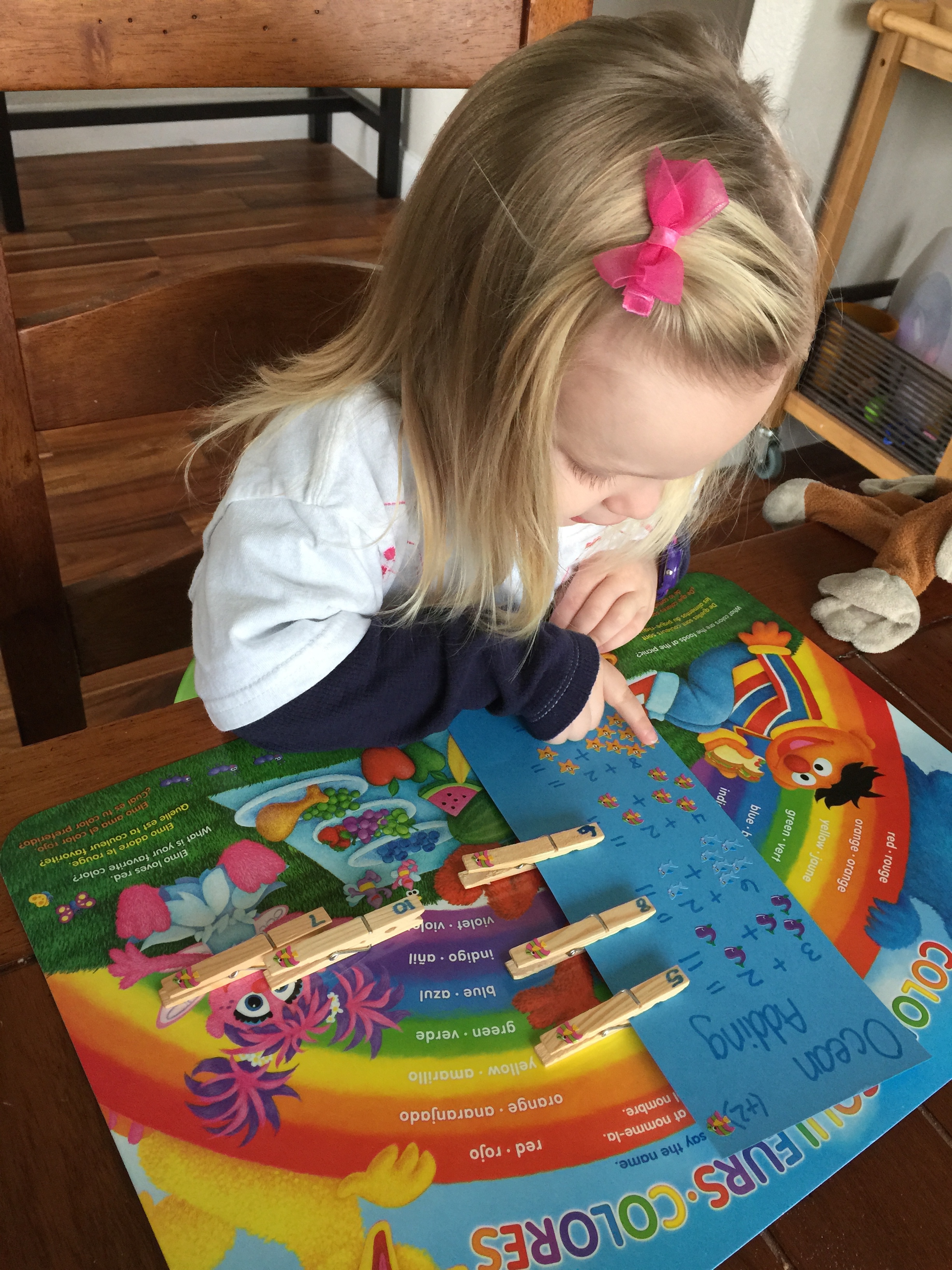
Math Clips Addition Matching Game

steam activities header

Our STEAM Subject today is MATH!

There are SO MANY times that I get frustrated.  It’s really hard to be the mother of a gifted child who is VERY asynchronous in her development.  I see all these adorable activities on Pinterest that are age appropriate for her, but they are color matching.  Or they are shape sorting.  And while those activities might be fun and totally appropriate for 98% of her peers, they aren’t appropriate for Becca.  She doesn’t like to do things that are too easy.  The girl wants to be challenged.  A lot.  And that’s fabulous.  But, it does create quite a frustration on my part.  She is super into math.  She wants to add and subtract food from her plate (which we do frequently).  She wants to add and subtract shoes from the shelf (which we also do frequently).  But addition and subtraction activities without manipulatives usually equal a worksheet, which she HATES doing.  And I don’t blame her.  Worksheets remind her that she can’t write yet.  And then she gets frustrated.

So, I’ve been wracking my brain to come up with some ideas for games that are similar to those color matching / shape sorting type activities, that cover the skills she’s ready for.  Enter my

math clips

I had a bunch of little ocean stickers, so mine are ocean themed.  You could do conversation hearts for Valentines day, or stars, or dinosaurs – whatever you have of the little tiny incentive chart stickers.  Note: your child may not need the stickers to count.  Becca doesn’t use them some of the time.  But they make it more age appropriate and fun!  Plus, it’s always good to have that visual reminder of what 8 starfish look like, what 7 turtles look like, etc.  I also put a sticker on the end of the clothespin so that the answers for each card can easily be matched to the correct card if they are all stuck in a large Ziploc bag together.  I did +2 and +3  with answers 5 and above.  But if you have more stickers and use a larger sheet (I just cut one piece of card stock in half lengthwise), you could easily do larger numbers.  Or, you could do much smaller numbers if your child isn’t quite ready for the big answers, and/or is still needing to sit and count each sticker to get to the total.  I love how easily this activity can be modified to fit the needs of the child.  And honestly, wouldn’t this be a fabulously fun activity for 1st graders learning addition as well?

IMG_2395 IMG_2396

Note: clothespins can be very challenging for a child who struggles in the fine motor department.  Becca has had lots of practice and still has trouble – especially since these are on the right side of the paper and she is left-handed.  If your child is struggling with the clips, it helps if you hold the card for them so that all they have to worry about is putting the clip on.  They may also need you to hold their hand to help them squeeze if their pincer grip isn’t very strong.

Supporting Your Lefty

supporting your lefty

A conversation recently came up over on my Facebook page about how to support a left-handed child – especially when that child might be the only one in the family who is a lefty.

I myself am right-handed.  But Cody is a lefty, and so is Becca.  Time will tell which hand Grayson will prefer.  There’s a lot of research out there on the topic, and it seems from what I’ve read, that noone really agrees on when a child has actually made the final decision about which hand they will use.  Some of those “experts” would say that you can’t possibly know until a child is 5, 6, or 7… while others say you usually know by 18 months, and others say even before that.  But anyway, how do you help that left-handed child in a world made for right-handed folks?  (All research agrees that only 10% of the population are left-handed.)

It can be a challenge.  MOST “touchy-feely” books only have the feeling spots on the right side.  Desks for school children are made to support a right arm.  Most spiral notebooks are bound on the left side.  Scissors are often hand specific.

But take heart!!!  Mirrors are a fabulous thing.  It’s also great to sit across from your child to model something for them – so they are looking at your mirror image.  And, I have noticed that Becca tends to use her right hand for some things simply because that’s what she’s seen me do over and over, and it’s easier to mimic.  Cody says that he uses his right hand a lot for things, too – including his computer mouse at work – simply because that’s the way the world works.  I think left-handed folks end up having to be more ambidextrous than those of us who are right-hand reliant.  I can do a lot with my left hand, but I don’t hardly ever lead anything with my left hand.  Becca can use both hands fairly well.IMG_0422
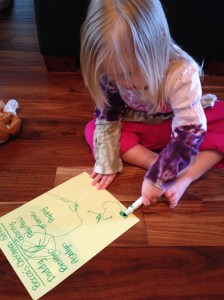
When teaching her to eat with a spoon, and also to pour water, we talked about with hand is her strong hand, and which hand is her helper hand.  Her strong hand holds the spoon or the pitcher handle, and her helper hand holds the bowl/pitcher to keep it steady.  By using “strong hand” and “helper hand” I didn’t ever slip and say left and right and end up mixing them up.  She has a very good grasp of left vs right, and has for a long time, so it’s been very important to me to explain to her that everyone has a “strong hand” and a “helper hand,” but for some people one is the left and the other the right, or visa versa.  She has the example of Mommy and Daddy having different “strong hands” to look at.  If you don’t have another lefty in the family, it’s a great way to talk about the concept of how everyone has strengths and weaknesses in their physical abilities, and that we use our bodies sometimes in different ways.  (Also note – a left handed writer isn’t always a left-footed kicker!  Becca is definitely right footed.)

So, that’s my two cents.  The rest of this post is a compilation of websites that I’ve found that have information about having a left-handed child.  Some of them are from researchers, some are just from ordinary folks like me and you.  So, be sure to view the information at the top of the page when you visit the link so that you know how much stock you want to put in what that particular source is sharing.  I am also listing at the bottom several helpful products from Amazon that you might want to purchase to help your left-handed child.  Those products are all affiliate links, and I appreciate your purchases! 🙂

Not sure which side is dominate?  Check out these simple tests from http://www.childcarequarterly.com/spring07_story3.html
“Eric Chudler, University of Washington, has a Web site called “Neuroscience for Kids.” It includes games, quizzes, and links to brain development and function. The following activities are adapted from his work. Each activity offers school-agers opportunities for charting and graphing, surveying, and evaluating evidence. Have plenty of chart paper and markers on hand. Encourage children to make notes of their observations. If your classroom has Internet access, children can upload their data and exploration results.

Left hand or right hand? 
Rather than ask children which hand they use, set up observation experiments that rely on more than self-reporting. Prepare observation charts with three columns: Left Hand, Right Hand, Either Hand. Have observers chart peers in tasks such as using a fork, painting at an easel, turning a door knob, and throwing a ball. 

Left foot or right foot? 
Set up the same observation system as in the previous activity. Have observers chart their peers in tasks such as kicking a ball, walking up stairs (Which foot steps first?), time spent balanced on each foot, and stepping on a picture of a cockroach.

Left eye or right eye? 
Check for eyedness. Chart these tasks: looking through a paper tube, looking through a magnifying glass, and winking (Which eye winks more easily?). 
You can chart eye dominance too. Cut a coin-sized hole in a sheet of construction paper. Ask the subject to hold the paper and look through the hole at a distant object using both eyes. Ask the subject to bring the paper closer and closer to the face while still looking at the object. As the paper comes close to the face, only one eye will be looking through the hole. Which one?

Left eat or right ear? 
Chart which ear is preferred in different tests. Which ear does the subject cup to help make a whisper louder? Which ear does the subject hold against a small box when trying to determine what’s inside? Which ear does the subject hold against a door to hear what’s going on outside?”

Lefty Links:
http://www.childrenshealthnetwork.org/CRS/CRS/pa_lefthand_pep.htm

http://www.lefthandedchildren.org

http://www.parents.com/kids/development/physical/raising-a-left-handed-child/

http://www.education.com/magazine/article/Left_Left_Left_right_Left_Tips/

Lefty Products From Amazon:

Fiskars 5 Inch Left-handed Pointed-tip Kids Scissors, Color Received May Vary

Kona K2LTSB Left-Handed Acoustic Electric Dreadnought Cutaway Guitar in Tobacco Sunburst Finish

Razer Naga Left Handed MMO Gaming Mouse

Le Creuset Revolution Silicone Left Handed Saute Spoon, Marseille

Westcott School Kumfy Grip Left Handed Kids Scissors, 5-Inch, Blunt, Colors Vary (13594)

Roaring Spring “Lefty” Notebook, One Subject with 1 Double Pocket, 11 x 9 Inches, 100 sheets, College Ruled, Assorted Color Covers

EasieEaters Curved Utensils – Left-handed Utensils without Shield

I’m Left-Handed What is Your Super Power? Lightning Bolt Navy T-Shirt

TOPS Lefty Kraft Cover Notebook, 9 x 11 Inch, College Rule, 80 Sheets, Assorted Colors (65128)

Plus check out this book – I think I’m gonna have to get it!
Your Left-Handed Child: Making things easy for left-handers in a right-handed world


UPDATE 3-30-15 – CHECK OUT THIS FABULOUS SET OF TIPS!!!  http://www.schoolsparks.com/blog/teaching-a-left-handed-child

Vinegar Science

steam activities header

What better way to start off our STEAM Thursday series than with some good ole vinegar science?  Vinegar science posts are a dime a dozen, but hopefully some of what we did will inspire new ideas of how you can take your basic activity to extend it further.

A couple of basic supplies that we’ll be using in many of our STEAM activities are a set of plastic beakers, and plastic pipettes.  I ordered them off of Amazon – here are your affiliate links to help you set up your science supply shelf!

Plastic Beaker Set – 5 Sizes – 50, 100, 250, 500 and 1000ml

Plastic Transfer Pipettes 3ml, Gradulated, Pack of 100

Some other items I recommend you picking up are some plastic trays (they are fabulous for any craft activities) – I got these cute heart shaped ones we’re using for this activity over at Dollar Tree.  We also have some fabulous activity trays that I got from Lakeshore, and I’ve heard that some Walmart stores carry similar trays.  If you’re looking for a quick order off of Amazon, here’s a great set.

ECR4Kids Flat Activity Trays Set of 5 (Non-Slip)

For this activity, you’ll also need vinegar, baking soda, and food coloring.  We also used paper towels.  The lab coat is of course optional – I used to sell Pampered Chef cooking products, so my chef’s coat is now her lab coat / painter’s smock. 🙂

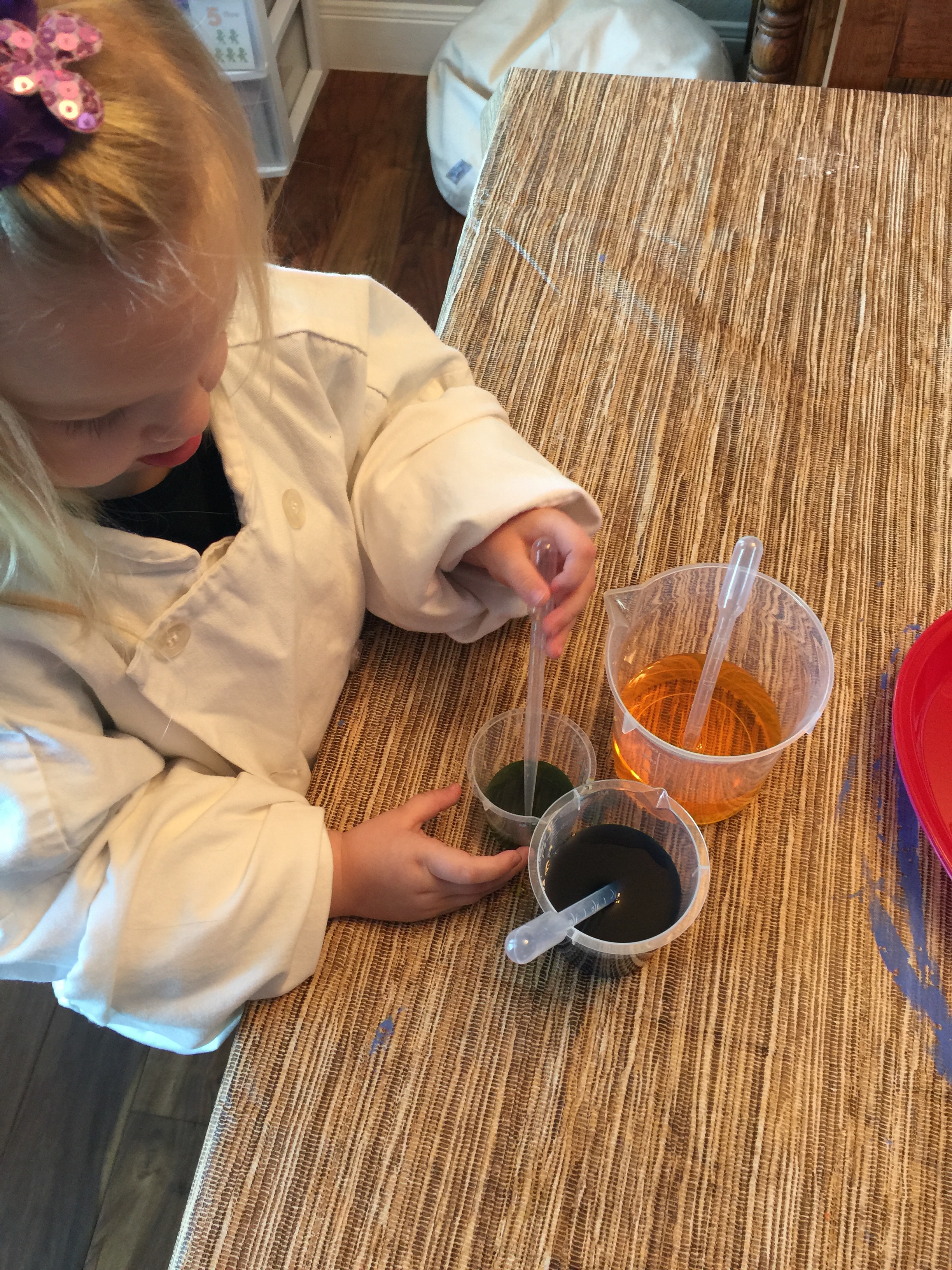
IMG_2279 IMG_2281

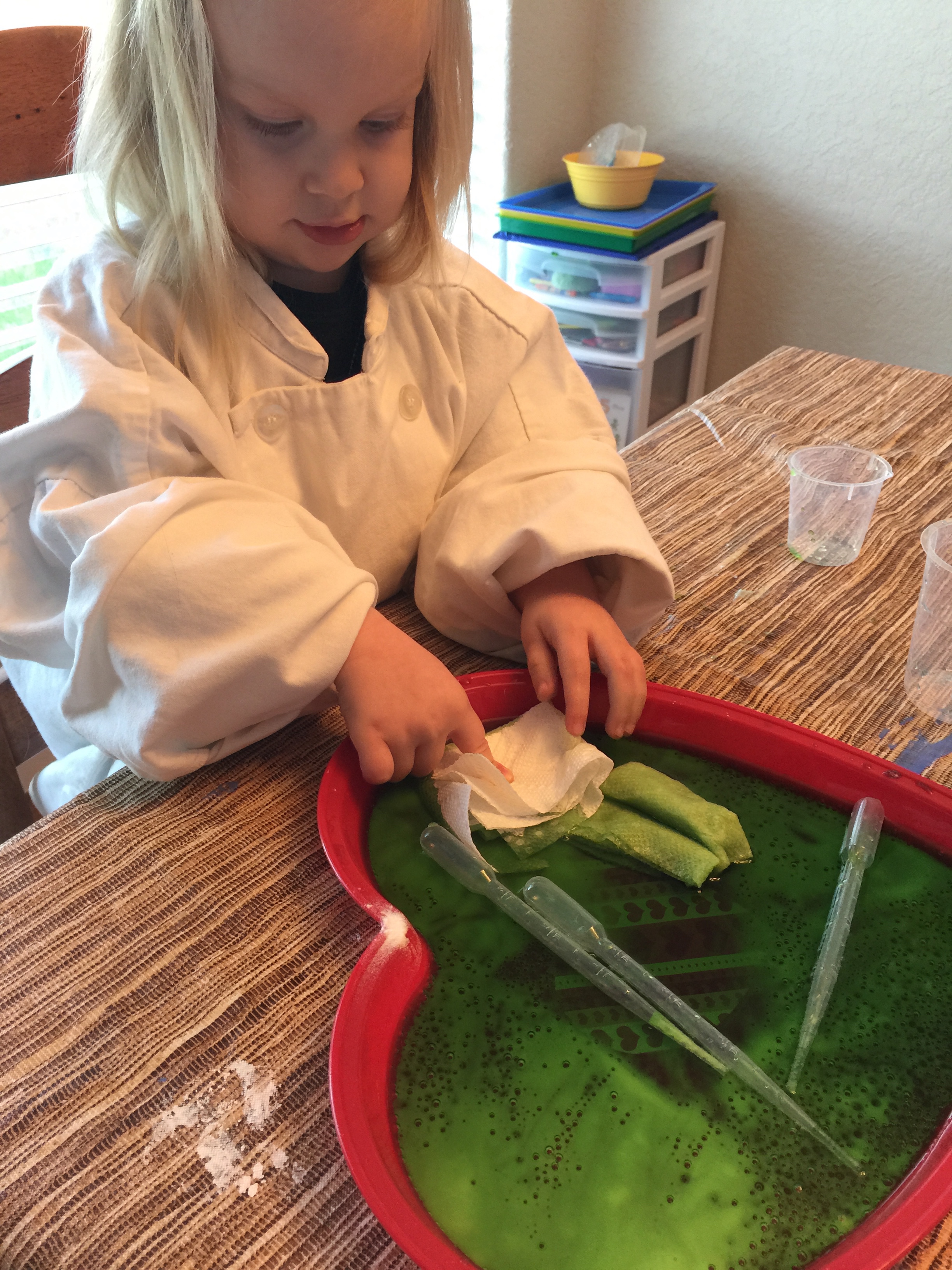
You can make this as basic or as complex as you want.  Here she’s doing the first steps – I put vinegar in two beakers, and she decided she wanted to make green, so we did blue and yellow.  She stirred the coloring in with her pipette, and then squeezed some of each color over into the smaller one to make green.  Talk about good hand-eye coordination and fine motor skill work!  It took a bit of practice to get the colored vinegar to move, but she go the hang of it fairly quickly!

IMG_2282

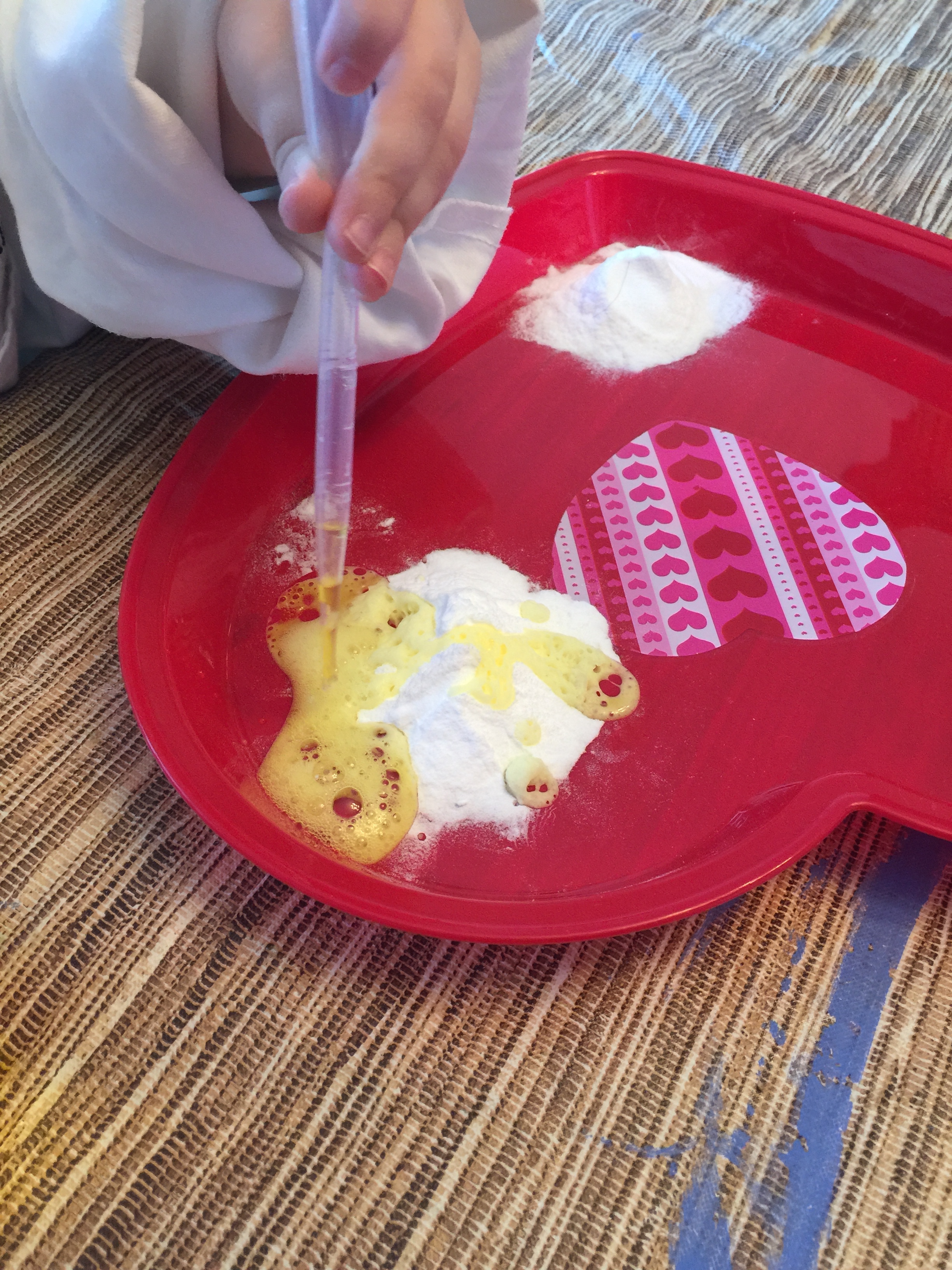
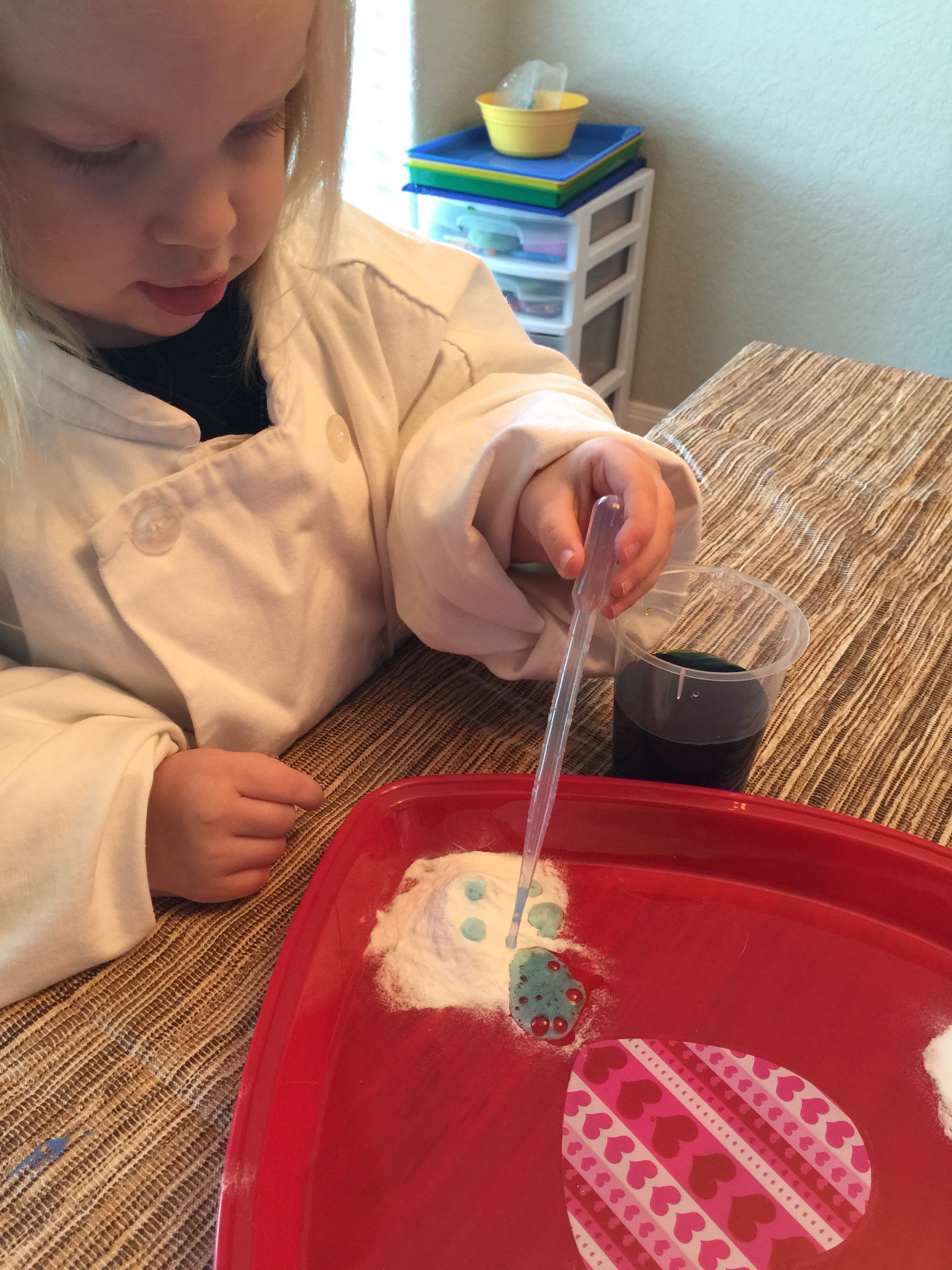
Then we took our tray, and made three baking soda mountains.  She enjoyed squeezing the colored vinegar onto the baking soda and seeing the colored bubbles!

IMG_2284 IMG_2285

So that was where my intentions for the project ended.  The rest is all Becca.  And that’s the beautiful thing about having an open science experiment time with your kiddos.  LET THEM LEAD.  They’ll take you amazing places.

IMG_2292

First, she decided that she wanted to dump ALL the vinegar into the tray.  Talk about big bubbles and lots of giggles!!!  The whole heart turned green, and she was super excited.  Then, she drew in the remaining baking soda with a pipette.  So suddenly we were doing art in our science experiment.

IMG_2294

Then, she discovered that the pipettes float!  But, if you fill them up and then put them in, they sink.  And, when I used a paper towel to clean up a spill, she thought it was awesome that part of the paper towel was yellow, part was blue, and then where they touched, they were green.  And then, the paper towel fell into the tray.  And thus began the TRUE experiment portion of our science time.  She loved watching the water soak into the towel, so we folded paper towels with different amounts of folds to see which would take the longest to soak up the water.  And then we stood up a paper towel in the water and she learned the words “capillary action” in regards to how trees take water in through their roots and the water spreads upward through the tree like the water spread upward through the paper towel.  I never expected my 2 1/2 year old to be able to repeat “capillary action” to her Daddy and explain it’s “like the trees getting water from the ground”… but ya know, I never expected lots of things when it comes to Becca.  She’s definitely my little science expert.  I’m so curious to see what career path she will choose some day.  Whatever she does, she’s gonna be amazing.

IMG_2297 IMG_2302

I hope that this, the first of many STEAM activities for the year, will inspire you to get into the kitchen (or dining room as the case may be) and start experimenting with your kiddos.  And don’t be afraid to let them lead you to a place you didn’t plan to go.  Because they might just be ready to learn about capillary action, too.  Or not.  Let them lead… and be prepared to follow.  (But don’t worry, if they lead you to a place where you don’t know all the answers… that’s what the internet is for!)  🙂

Animal Habitat Sensory Play

The day after Thanksgiving, we got to spend a tiny little bit of time with my best friend and her family at their home, and I got an idea from her that has become one of Becca’s all-time-best-loved “actiperies” (she can totally say activities now, but she still calls them actiperies b/c she knows I think it’s cute. ha!).  She has always had a big fascination with animals and their homes, but this takes it to a whole new level… so thank you, Rena, for the inspiration!!

Arctic Habitat

IMG_0999
What you need:
Storage Container
Flour
Sugar
Powdered Sugar
Corn Starch
Safari Ltd Arctic TOOB (aff link – thank you!)

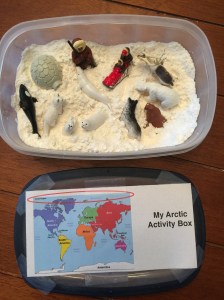
It’s super simple – use a little bit of each of the first four ingredients and stir it up in a container.  Then add your Arctic TOOB animals, eskimos, and igloo, and you are ready to play!

IMG_1002IMG_1009
An old toothbrush made a fun addition, and great fine motor practice – as she decided to brush the snow off of the animals and people.


Antarctic Habitat

IMG_0998
What you need:
Storage Container
Rock Salt (I used Ice Cream Maker Salt… b/c it was on hand)
Kosher Salt
Table Salt
Safari Ltd Penguins TOOB

Same as above – add some salt and stir up in a container, add your penguins, and you’re ready to play!IMG_1026

We also added some play “snow” from our ornaments project because she really wanted to make it snow on the penguins. 🙂

If you’d like, you can print out the maps and titles I made to tape to your lids.
FREE PRINTABLE HERE! 

Enjoy!  And be prepared – the Arctic box’s “snow” might make dark clothes turn white. 😉

IMG_1016

Christmas Treasure Box

Back in August in my post, Buried Treasure, I had made a little storage container of beans, and hidden pom poms.  She enjoyed that activity for a while, and then I recycled the beans over to her sensory table for our big Thanksgiving activity… but the idea is BACK… for Christmas!

IMG_1233

I was grocery shopping and on the dry goods aisle, I saw a bag of split peas, and there the idea was born. I grabbed that $0.88 bag, a $0.64 bag of rice, and I was done!  I already had at home the other items needed for this box.

Here’s what I used:
1 bag split peas
1 bag rice
Mint extract (b/c it’s what I had, you could use essential oil)
Vinegar
Red food coloring (it pretty much took the whole tiny squeeze bottle for it to not look pink, so be prepared)
A large Ziploc bag
Wax paper
A large Ziploc storage box
Treasure, a scoop, and a bowl

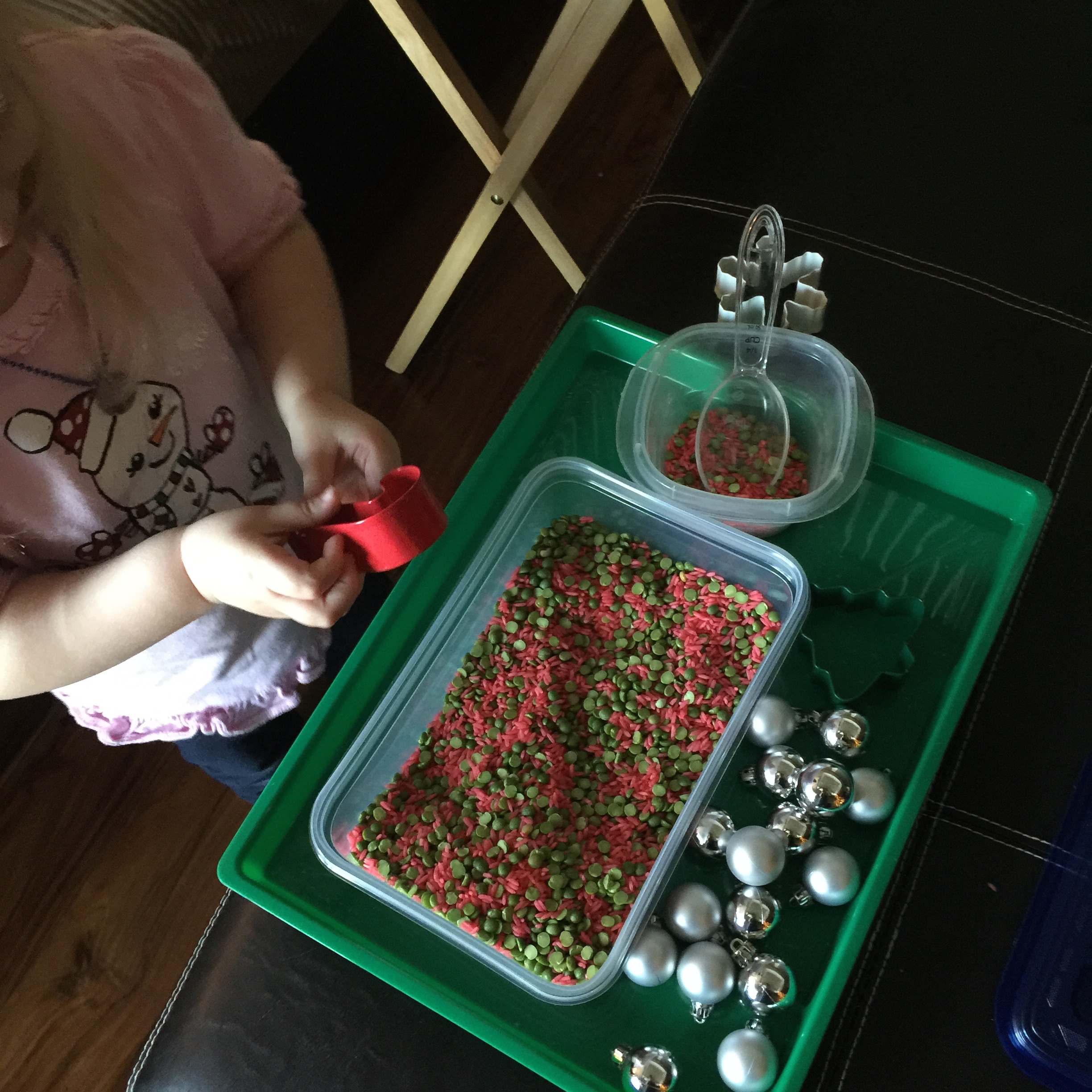
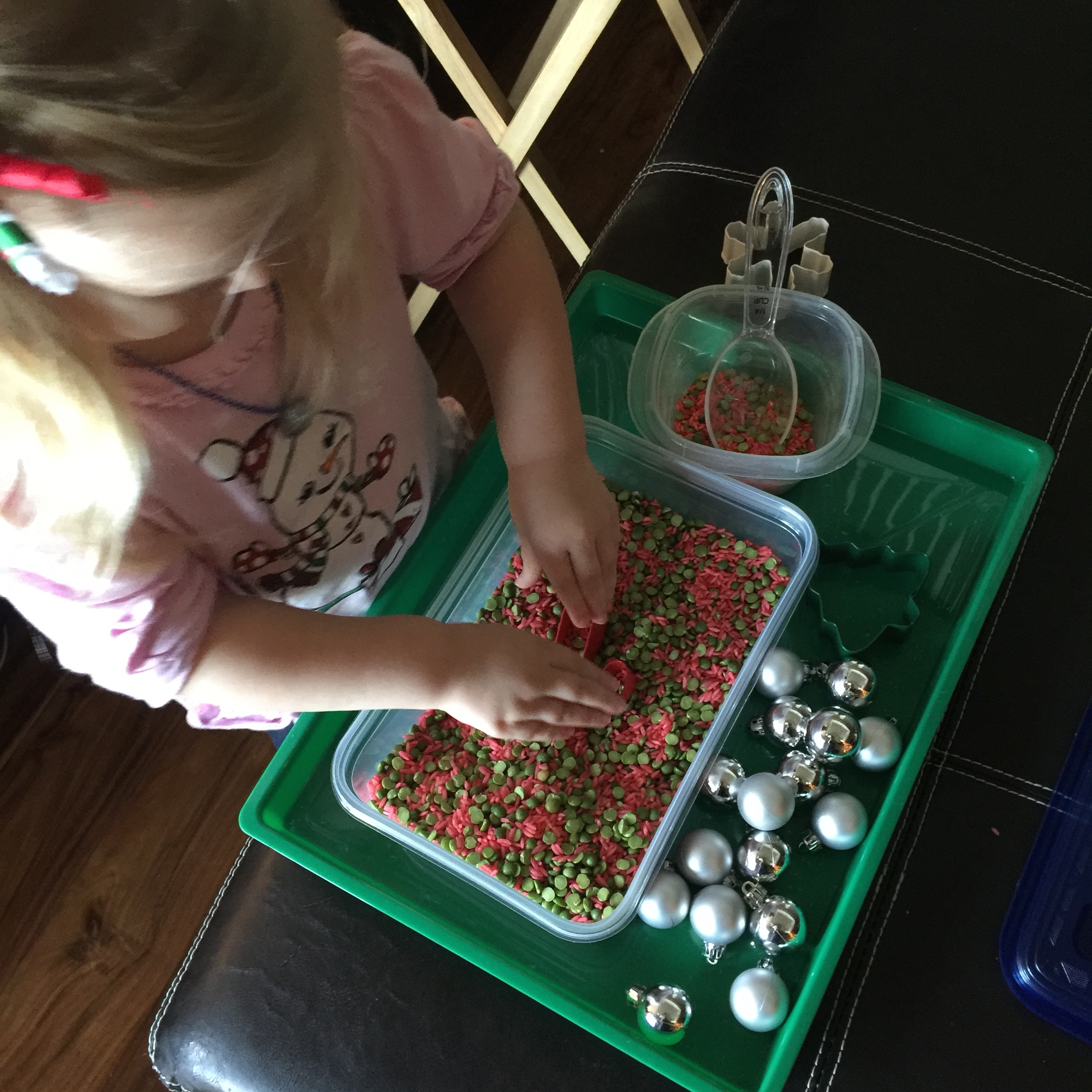
So to make the rice red, you’ll dump your bag of rice into your big Ziploc bag (I used a gallon storage bag), add 2 Tbsp vinegar, and then lots of red.  I think I ended up counting like 45 drops before I got it really red.  The gel food coloring supposedly works better – I haven’t tried it b/c I just always use what I have.  Thinking I’ll buy some next time.  Then, if you’d like, add a few drops of your Mint scent – you could use Essential Oils if you have them, or if you happen to have Mint extract on hand from cooking, that will work too – that’s what I used.  Shake it all up really good, and spread it out on wax paper to dry.  Once it’s really, really dry (give it several hours), you can combine the peas and the red rice in the storage box.  Then I had some little shatter proof ornaments ($1) and some cookie cutters I put in the box to be her “treasure.”  She has LOVED hiding the items under the peas and rice and then digging them out.  We even tried a candy cane ornament from the tree, as well as a bracelet.  The possibilities for treasure are endless!

The best part about this activity was it’s cost and how quickly it all came together once the rice was dry – on a day we had a ton of other stuff going on, no less!  And she loves it!  SCORE!

IMG_1114 IMG_1115 IMG_1116