Sauce Painting for Baby Bees

artRemembering that every child is super different has been hard for me.  I’m sure every mom struggles with it.  I’ve heard myself say “Why aren’t you like your sister?” And then the guilt comes washing in like waves beating up the seashore.  I don’t WANT my Baby Bee to be like his sister.  But certain similarities sure would be nice.  Like if he would get over this need to put EVERYTHING in his mouth!!!!  By this point with my Big Butterfly I was doing arts and crafts and sensory bins and more… Because she didn’t put things in her mouth!!

But I realized (finally) this last week that I need to get over that.  He isn’t his sister.  And I don’t want him to ever be… So, one of the main ways he explores his world is with his mouth.  He’s still majorly teething, and he needs to feel textures with his mouth to help combat his pain.  That’s why he licks touch-and-feel books.  That’s why he gnaws on everything.  Because his mouth isn’t finished doing a lot of really painful work, and he’s very aware of how it feels.
So, all of that is ok because it’s who he is.  However, it does make my life quite difficult.  I want him to be able to do fun things like I do with his sister… And he will in time.  Until then, I had to find a way to let him do things his way- that were safe for him.  Enter food.
I know there is a lot of controversy about using food as a manipulative for anything other than eating, but when you get desperate to provide experiences for your oral child, food is a FABULOUS way to safely allow participation – and exploration!
sauce painting
Sauce Painting is probably the easiest activity I’ve ever had to prep… Don’t buy anything!  Just set up your child’s highchair tray with a variety of sauces you already have, put them in the chair in just a diaper, and be prepared for a bath afterward!  It’s so fun to watch as your child experiments with the different textures, colors, color mixing, and of course, tasting!!
I will add here, however, that for once Gray never put his hands in his mouth!  Had I used paint, I’m sure he would have had it head to toe – including internally… but since I used yummy sauces, he of course decided not to indulge.  He truly keeps me guessing!!
For the painting aspect, I just grabbed a piece of scrap paper (this isn’t going to be the Van Gough you hang on the wall, mom – it’s going in the trash after you take a picture of this fabulous work of finger paint art… so don’t waste good paper on it!!) and let him paint!  He also got “paint” all over the place mat and the table, so a plastic table cloth taped down ahead of time might be worth the prep time if you are really picky about messy activities.
Sauces I used: Tarter Sauce (he LOVED the chunks!), Ketchup, BBQ sauce, Spicy Brown Mustard, and Honey Mustard.  You could use anything you’ve got that is paint consistency.  Mayo, regular Mustard, anything like that would work.  Remember that if you’ve got an oral kid, there ARE ways around it, and you can totally still provide them with art experiences… you might just have to experiment and step outside your “normal” box of crayons, markers, and water colors.
Cardboard Boxes

When Becca and I had our recent discussion about what things she’d like to learn, she mentioned wanting to know how boxes are made.  And since then, she’s mentioned it several times.  So I thought I’d share what we did in case some of your kiddos have the same questions!

First, I set up a new “How it’s Made” Playlist on my YouTube channel, so you can click over there to check out several fabulous “How it’s Made” video clips that you and your kids will enjoy learning from!  We watched the cardboard box video probably a total of 5 times – she kept not remembering certain parts or wanting to re-watch because she had questions still.

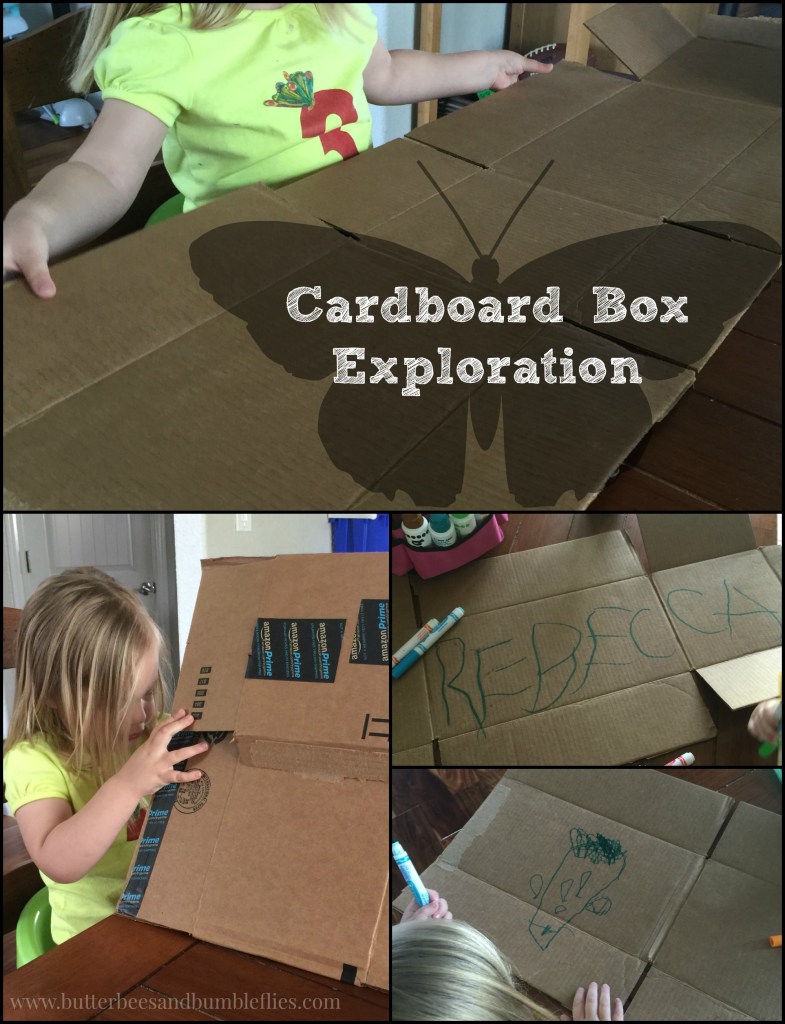
cardboard box explorationThen, we took a regular cardboard box from our recycling pile, and took it apart.  We found where the seam was, and “unglued” (her word) it.  Then, she enjoyed decorating the inside with some custom artwork, and she helped me re-glue the box back together – inside out.  We used a little tape to help the glued flap stay closed.
diy cardboard

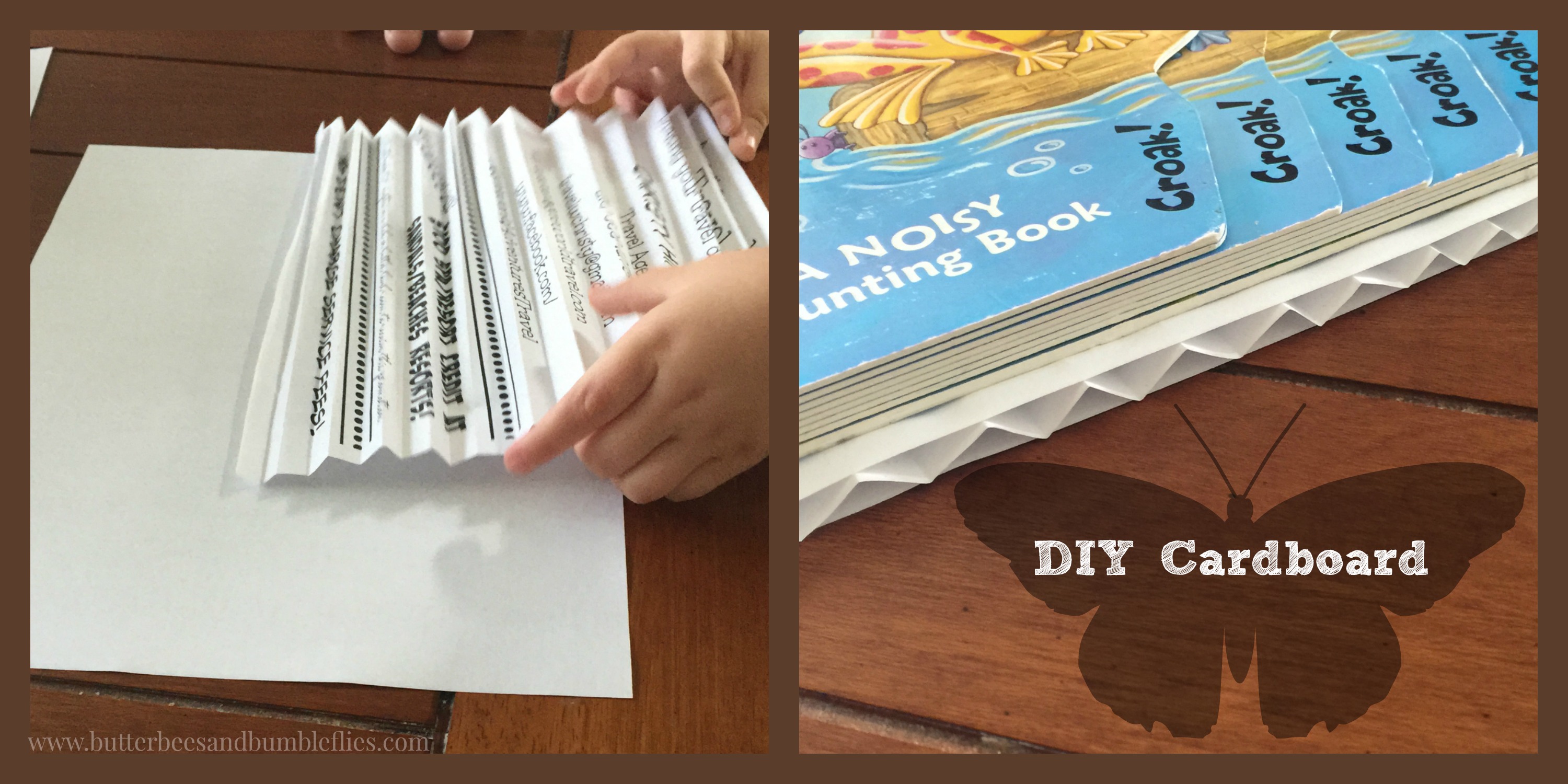
With Daddy’s encouragement, we took it a step further, and made our own cardboard!!  She was most fascinated with the process of making the cardboard itself, so he suggested getting three sheets of paper and making our own!  She wasn’t able to make the “fluting” by herself, so I did that part, and then she enjoyed adding the glue and sticking each sheet on.  We set a book on top of it for it to dry, and she was AMAZED when it was dry at how strong those three once-flimsy pieces of paper were!!  It was a great experiment, and I’m glad he encouraged us to take it a step further.

She really learned a lot from this lesson, and when I asked her if she felt like she adequately had had her questions answered she replied with a hearty “yes, I did!”  Mission Accomplished.

Math – Made Fun with Food Pouch Lids!

steam activities headerWelcome to another STEAM Thursday!  Not sure what STEAM is?  Check out my STEAM page here, and peruse through all of my previous STEAM posts!  Today’s topic is Math – specifically adding, subtracting, counting by 2s and 10s, geometry, and patterning.  But, as usual, we have also squeezed some engineering in too… we seem to find a way to do that with everything these days!

food pouch lids

Last fall, I shared some ideas for what to do with all those extra food pouch lids you might have sitting around your house… and today I wanted to expound on those ideas a bit.  I briefly mentioned making patterns in my previous post, but Becca has been interested in making more complex patterns, so today we tried a really hard one – peach, pink, pink, pink, peach, peach, pink, pink, pink, peach.  She continued the pattern correctly – pink, pink, pink, peach, peach, pink, pink, pink, pink, peach.  (I didn’t get a picture).

In the process of stacking them up to make the pattern, we ended up building pyramids and cubes as well.  Then we discovered that simply stacking them on top of each other makes a cylinder!

Our main focus, however, was adding and subtracting.  Just like you might use a ten grid to add and subtract with counters, I simply took some scrap paper from our recycle pile and drew ten rectangles on it that we used for our pouch lids.  We started out with basic equations to remind her how the ten grid works (it’s been a while since she’s seen one), but then we got more complex by adding her ten grid to mine to see how many pouch lids we both had combined, or subtracting hers from mine to see how many more I had, or reverse.

I was able to show her the physical ability of the pouch lids to cancel each other out to subtract and find the difference more quickly.

We practiced counting by twos to put the lids into groups of tens, and then counted by tens to see how many lids we have.  We compared the groups to see which color we had more of, and which color had less.  Then we subtracted by canceling out the groups of ten to find out how many more pinks we had than the peaches.

If you saw my post on Monday, you know that Becca considers math “kind of schoolish” and not really “summer fun…” however, she stayed so engaged with this activity that when I said, “So, did you enjoy doing math today?”  She said, “If all math was like that, I’d love it every day!”  HA!  So, now I’m on a mission to make math much more hands on and fun for her!  And you can bet that we’ll be doing a lot more with these food pouch lids in the future!!!

If you have kids who like applesauce (or anything else) in a pouch, SAVE THE LIDS!!!  There are just so many fabulous things you can do with them.  The possibilities are endless!  Please share – what are some ways you reuse your food pouch lids?


Building Duplo Sentences and Pronoun Matching

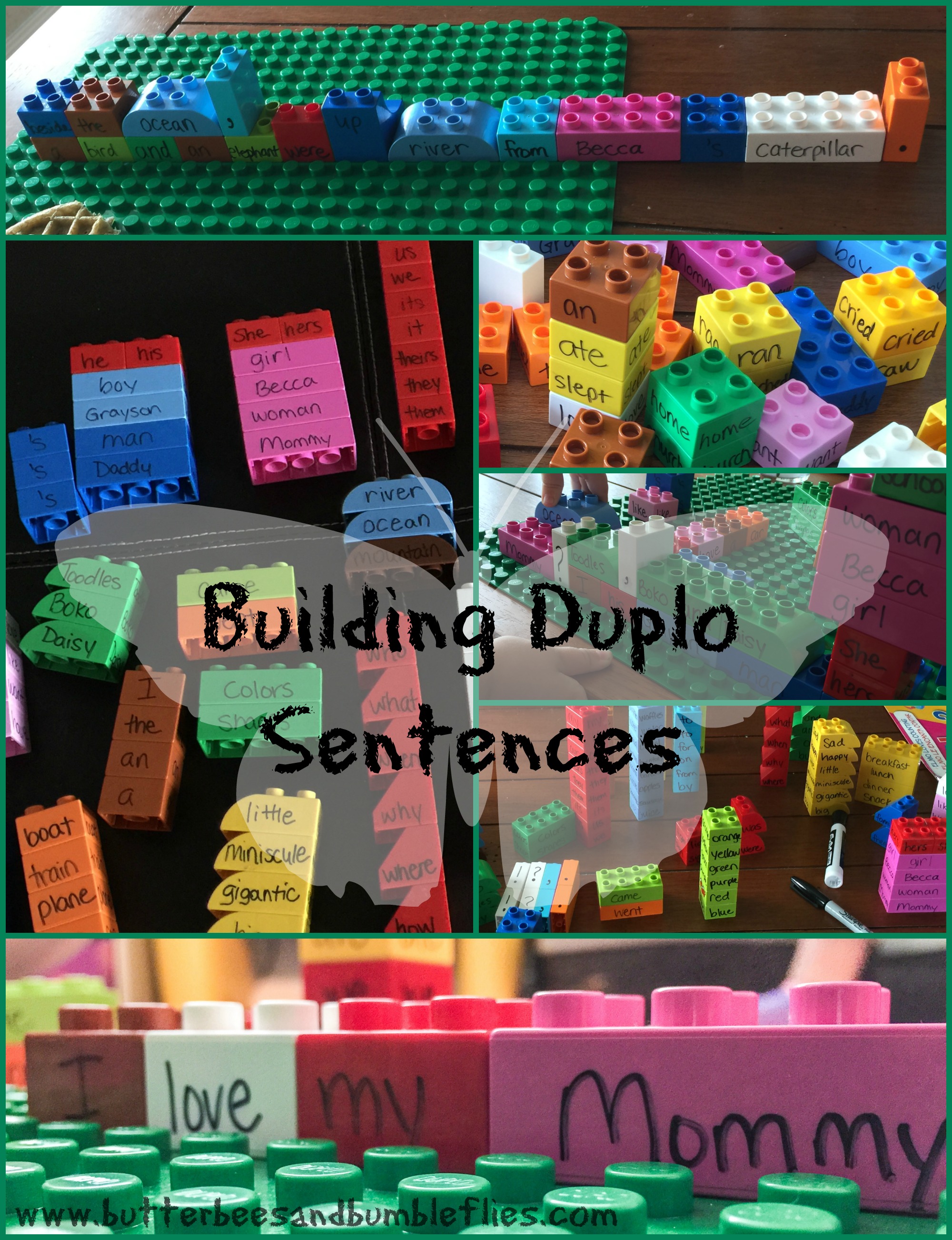
duplo sentencesI saw this idea from Allison McDonald, over at No Time For Flash Cards, and I thought it was really cool… but wasn’t sure how to relate it to Becca.  Then one day it hit me.  Sentences.  Becca is always wanting to write.  But due to her very asynchronous development paired with her perfectionism… she is unable to write in a manner that looks correct to her, so she doesn’t enjoy writing.  She gets very frustrated.  But this way… this way the world is opened to her.

I started by taking the Duplos that she already had and writing a bunch of words on them.  We did the activity and then we discovered I had inadvertently forgotten to make any prepositions.  And we needed color words.  And adverbs.  And… and… and… she thought of more words than I had ever dreamed of.  SO, since we needed to go to Toys R Us that afternoon anyway, we got another set of Duplos.  Because truly, we can’t ever get enough of them around here.

As of today, she has 169 words and punctuation marks.  (And that includes three blocks with ” ‘s ” written on them.)  She keeps thinking of more words she wants.  I told her that she’ll need to wait a while because we aren’t going to buy any more Duplos right now.  She wants me to write words on all of her brother’s Duplos too… which I have also held off doing because his go to specific sets.

I love the tenacity with which she approaches building her sentences.  Sometimes she likes to build silly sentences just by putting words together that don’t make sense.  Sometimes I think of sentences and have her hunt through all the blocks to find the words that are in the sentence.  And sometimes she comes up with things on her own that just blow me away.  When she wrote “I love my Mommy,” I couldn’t help but smile.

She has discovered that she can also build sentences vertically, and she loves sorting the words by type (which I made easy for her by matching the colors – all the verbs are yellow, food nouns are light blue, pronouns are red, etc.)  It’s a great way to talk about types of words, appropriate punctuation marks, sentence structure.  She can write stories by building them vertically, or by making them wrap around the table.  It’s also a great way to practice sight words if you have some words your child is struggling to remember.

I love the flexibility that comes with this activity, and that she still has the ability to use her engineering skills to build fun towers as well.  For example, yesterday I told her to forget there were words on the blocks, and just build something cool.  Then after she was done building, we read all the words in order and giggled at the silly nonsensical story she had written!

I also made male and female word sets to reinforce male and female pronouns, and that can be an activity in and of itself sorting them into the correct stack.

pronoun matching

We have a bunch of flat Duplos that I haven’t been sure what to do with… and I think I’m going to use them for math facts.  Whatever I decide to do with them, you can be sure I’ll share.  What ideas do you have for fun ways to use Duplos?

This post was not sponsored in any way by Lego Duplo… we’re just a family who loves Legos and Duplos and has an overabundance!


Mystery Messages

steam activities header

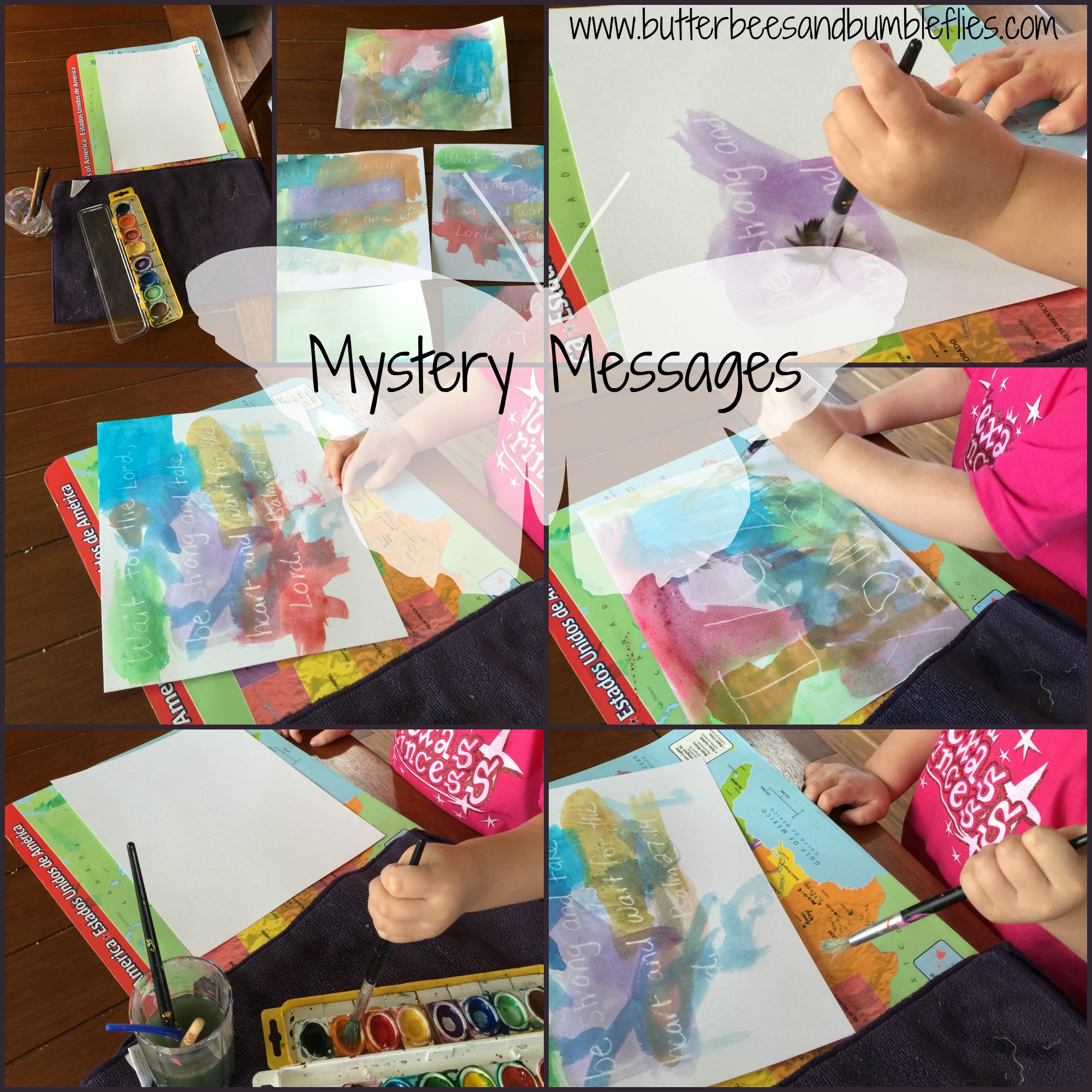
A super fun way to spread the word… about anything… is to make it a mystery!  Whether your child makes the message, or you do, there’s nothing quite so exciting as taking what appears to be a blank white sheet of paper and turn it into a special message!  Becca simply loves doing these crayon resist water color paintings, and with this activity your options are truly limitless!mystery messagesJust take your white crayon and write a message on white cardstock, then paint over it with water colors to reveal the mystery message!

Your mystery message could be a simple Bible verse, an I love you note, a reminder of your home address/phone number, or a sign for your child’s door!  You could easily make math fact cards or illustrate the life cycle of a butterfly.  The awesome part is the science lesson behind it all – water won’t stick to wax!  The colored water just beads and rolls right off.  Becca has decided that next we need to try mystery messages on other colors of paper.  So we’ve been trying to pair up the right shades of crayons to our paper stash to see if we can make mystery messages in more than just white!

Have you already tried crayon resist paintings with your kids?  Well, what about glue resist?  It’s a little more complicated – make your glue design and then allow it to dry thoroughly before painting.  You’ll have to also try different kinds of glue – what sort of results do you think you’ll get trying Elmer’s vs hot glue?

It’s so fun to get your kids to predict and then check their hypothesis!!  Introduce the scientific method early and often to your kiddos and they will learn to love science… as well as see how much it relates to everything in our world!