Magnet Exploration

I recently signed Gray up to take a class at The DoSeum – our local children’s museum that I have written about before.  The class is called “Little Makers” and it’s basically a science and engineering class for toddlers 18-36 months old.  Yesterday was our first class.  Not only did Gray have a blast, I came away very inspired…
magnets at the dose

His teacher, Ms Cheryl, had all sorts of magnets for the kids to explore with.  The invitation to play was simply a box of random items and a couple of magnet wands.  Gray immediately dug in and was ready to explore!  She had extension activities for those who were interested in sorting their magnetic vs non-magnetic items, and blank paper “journals” for any who wanted to draw/write their thoughts.  Gray enjoyed sorting his magnetic/non-magnetic items, and eagerly sat in my lap to sort them!  He enjoyed playing with magnets on the classroom divider wall, and of course he loved the story – Goodnight, Goodnight, Construction Site is one of our family favorites!  (Aff link, thank you!)  Then after class he enjoyed going to the Kaleidoscope play area and spending more time with the MagnaTiles there.  (Aff link, thank you!)  All of the magnet play inspired me, and we ended up purchasing our own set of  MagnaTiles to take home with us.

While he napped, here’s what I set up for when we got home from picking up Sis from Mother’s Day Out:
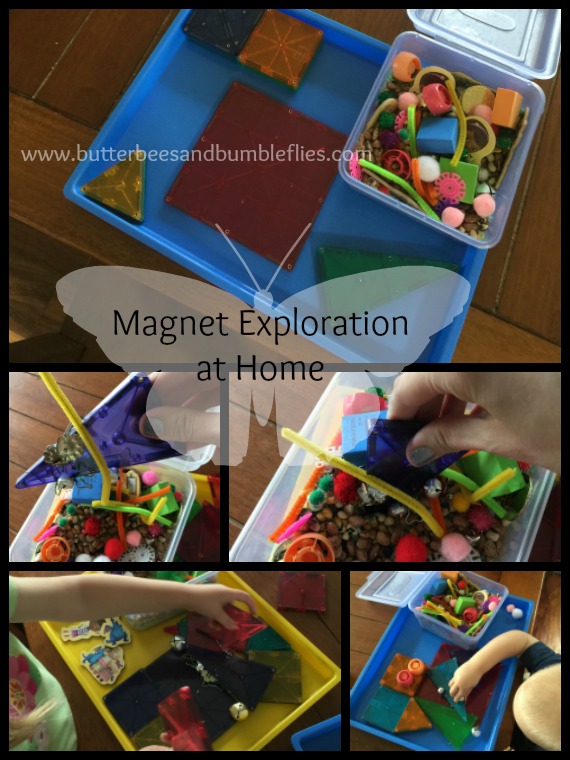
magnets at home The invitation to play was simple – a box full of random items both magnetic and non-magnetic, and a bunch of MagnaTiles.  When we got home, Becca immediately hopped up into her chair and started playing.  Without me even showing her or telling her what to do, she started testing items to see if they are magnetic.  Today, I’ll give her the same activity with a sheet of paper similar to what Gray had for sorting at the DoSeum and let her sort her items based on whether they are magnetic or not.  Gray also immediately dove in and really enjoyed the activity again at home in our little variation.

reality check

Because I’m all about being honest with you and telling you what works and what doesn’t work, this is NOT an activity for your toddler to do unsupervised.  I thought I’d take advantage of them being so engaged, and I’d do the dishes… well, then I looked over and he had something in his mouth.  Thankfully, it was just a pompom – not a magnetic item, but because he’s cutting a couple of new teeth right now, I can’t give him the box unsupervised.  This is an activity to do when I’m sitting right with him.  To buy myself some more time, I simply removed the box from his reach and let him play with the MagnaTiles.  He LOVES building with the MagnaTiles and that easily occupied him for the rest of the time I needed him to be occupied until I could join him at the table and let him have the box back with close supervision.

MAKING THE BOX
Here are some ideas of what you could put in your box.  I used the following items that I had laying around randomly here:
-Colored Rice (non)
-Mixed beans and corn from an old fall sensory bin (non)
-Paperclips (magnetic)
-Paper brads (magnetic)
-Refrigerator magnets (magnetic)
-Feathers (non)
-Pipe cleaners, cut into pieces (magnetic)
-Jingle bells (magnetic)
-PomPoms (non)
-Play plastic coins (non)
-Foam blocks (non)
-Fruit pouch lids (non)
-Plastic stackers (non)

Here are some other fun magnet activity sets that we have and enjoy (Aff links, thank you!):
MindWare Imagination Patterns (Becca got this for Christmas and loves it!  Gray has not used these… but easily could – they are large enough to be toddler safe, she’s just very possessive of them.) UPDATE: Gray loves playing with this set!  There are a couple of small circles that I take out of the set when he plays with it.
Magz51 New Interlocking Toy Building Set (NOT toddler safe)
Magnetic Spinning Gears (Both kids LOVE this set!)
Lauri – Fun with Magnets (I have this set on order and can’t wait for it to arrive!)

more fun with magnets
update 4/7/16: He loves playing with the Imagination Patterns AND the MagnaTiles together because the Imagination Patterns board allows the MagnaTiles to stand upright for vertical fun!

Children’s books about magnets (Aff links, thank you!):
What Makes a Magnet?
What Magnets Can Do
Magnets: Pulling Together Pushing Apart

What fun magnetic activities have you done?  The kids are totally enthralled and I’m looking forward to finding more fun magnet activities! I also think Becca would enjoy going on a magnetic hunt to test different household objects to see which are magnetic and non-magnetic… we may do that today!
 

Teaching Graphs

I’m not going to begin to put an age level on this lesson because I’ve sort of lost all realistic memory of when is the “right time” to do this type of activity.  SO, I’ll say that if you think it might be time for your child, you might be right!

Graphing is so much fun.  And it’s even more fun when you add in a technology element and work with your child to set them up in Excel or Numbers!  I have a Mac, so our work was done in Numbers.  The first step before creating any graphs, however, is to collect data.

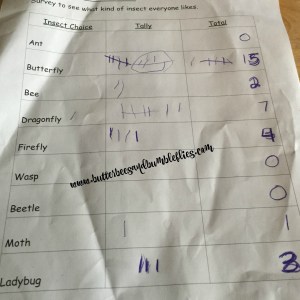
I came across this insect survey free on TPT and thought, somehow I have to make this work for Becca even though there isn’t a class full of kids to survey!  Enter social media.  I polled Facebook through my page (thanks to several friends and family members who shared my post!) and we received over 30 responses!

tally sheet

As I scrolled through the responses, I would read them out to Becca, and she learned about making tally marks.  She would mark the sheet, and then once we had recorded all of the answers, we counted the marks and I wrote how many of each insect had been “favorited” by our participants.  Making tally marks was a new experience for her, and she wanted to circle the groups of four instead of making a line through them for five to group them together.  Cody and I were both there for this lesson, and we had to explain to her that this isn’t something you can do however which way you want – to make tally marks, this IS the way to do it.  No other options.  She wasn’t real sure about that, which I dealt with again with her when we did our second grouping of data, which I’ll talk about later in this same post.

So, once we had the numbers for our insects, I pulled up Numbers and immediately set up a little data table.  She read off the insect names to me and how many of each one.  Then she decided what title we should put on our table.  I knew that I wanted to teach her about pie graphs AND bar graphs (she has seen some bar graphs before, but it’s been a while), so I first put the information into a pie graph, and she was immediately intrigued – she helped me select the colors that she wanted, and was very pleased.  She started asking questions about what % means… and I skirted around it by simply saying, it’s what part of the whole group it is – sort of like fractions.  She said “oh” and was actually content with that.  No doubt  percentages will be entering our math time very soon.  Then I let her select whether she wanted a vertical or horizontal bar graph, and she selected the color.  She decided that she needed some pictures of her top favorite insect to make it look a little “happier,” so I pulled up Google images, and had her type in “butterfly.”  She selected the image and I showed her how to save it.  Then she also saved a dragonfly and a ladybug.  I showed her how to import her photos into the document, and once I got them the right size, she dragged them to where she wanted them.  I had her tell me about her graphs and typed her words onto the “poster” as well.  We printed it out on card stock, and she was so proud to show her daddy!

becca w graph
Left: she typed in the words to save it to my computer, and was quite frustrated wanting to know what crazy person put the letters in the wrong order on the keyboard! HA!

Then, a couple days later, we colored Easter eggs with some dear friends.  And we had ALL. THESE. DANG. EGGS!  What to do with them all?  So after she had spent a good amount of time sticking butterfly stickers all over them, we sat down and made a tally of how many eggs we had of each color, and I had her draw a bar graph on paper so she would have the physical concept of what the bars show.  We talked about how “this is what three orange eggs look like in real life, and this is what they look like in tally marks, and this is what they look like on a bar graph!”  She said “that’s cool let’s put them on your computer.”  Hey, what can I say?  It’s really fun to make “graph posters” on Numbers!  So, for ease (and because it was almost bedtime) I pulled up her previous file, renamed and saved it as a new file, and then had her tell me the new data to type in.  She was quick to notice that I needed to change my titles on the data table, and told me what names I needed.  Instead of types of insects, I needed colors of eggs!  She decided this poster needed different graph colors, and of course it needed Easter egg images.  We also edited our text, and in about 7 minutes, we had a whole new graph poster about our Easter eggs!  We printed it and she was so excited again to show it off to her Daddy!

eggs

This is a super simple way to get your child talking about Science and Math AND to incorporate the Technology aspect of STEM as well.  Don’t have a computer or experience with Excel/Numbers?  No problem!  Drawing on paper can be awesome as well – you could draw on copy paper, cut them out, and post them onto a large sheet of construction paper!  Clip photos from magazines, or illustrate yourself with paints and markers!

I’ve noticed since doing these graphs, Becca is much more interested in Math again – not shying away from addition and subtraction story problems, and excited to count and sit to learn new math concepts as well.  Remember – Math HAS to be FUN!!!  Make it that way!

insect survey

egg graphs

Our Penguin Unit

Throughout this post there will be a variety of links.  Some will be to other websites or files for you to download.  All sources are credited where necessary.  There will also be affiliate links which will be denoted with (aff link).  When you choose to click on these links to purchase items, I make a tiny % of the sale profit off of that item.  That goes to helping keep this blog alive.  Thank you for your purchases.

So of course this blog post wouldn’t be complete without a little bit of back story.  I’ve said previously that I’m great about setting goals, but not so great about putting the nose to the grindstone and actually making them happen.  But this year that is going to change!  Because I’ve switched my focus from super long term objectives, so short term monthly objectives.  Especially when it comes to school at home.  Becca’s love for learning is voracious. She keeps me on my toes at all times.  She constantly is begging for more activities, more books, and asking more and more and yes, more! questions.  Since having her own dictionary and LOTS of other non-fiction reference books in her room the questions have backed off a little bit, but not entirely.  She just can’t learn enough, fast enough.

I used to stress out thinking that homeschool needed to look like me sitting down with her all day and actually doing instruction time.  All day.  Boy doesn’t THAT sound like a nightmare with a child who has SPD and has to move ALL. THE. TIME.  Except when she doesn’t because she needs to be wrapped tightly in a blanket and suck on her finger.  But then this fall I read a book that truly changed the way I think about homeschool.  I realized that what it looks like for somebody else isn’t going to be what it looks like for us.  And that is OK!  (Thanks again to Alicia Michelle from Your Vibrant Family for your encouragement and support every step of the way!  I believe I CAN do this homeschooling thing as long as I have to!  Which I not-so-secretly hope is not very long!!)

Anyway, I discovered that I can plan a STACK of activities for Becca and we can sit down and do them in an hour, or an hour and a half.  And then we are done.  I’m now realizing – that’s ok!  We go at her pace, I tell her what activities we’ll be doing, and she selects which order we do them in.  She gets to take breaks between them if she so desires, and play with learning games, engineering materials, etc.  (All of her breaks are STEAM breaks of some sort.)  When she is done, we take a STEAM break (want some STEAM activity ideas?)…  Then we get back at it.  All the while, Brother can play in his room on his own, and is perfectly content since it’s no more than an hour and a half time block.  (Yes, I am blessed!)

So back to those goals – I decided that it was time to do a thematic unit from start to finish.  And actually finish.  So I gave us two weeks.  Which was a perfect time frame.  She goes to Mother’s Day Out a couple days a week, and we often don’t do “school work” on those days, though sometimes we do.  Just depends.  I like having the flexibility to let her be three and a half, while also letting her brain be whatever age it happens to be that day.

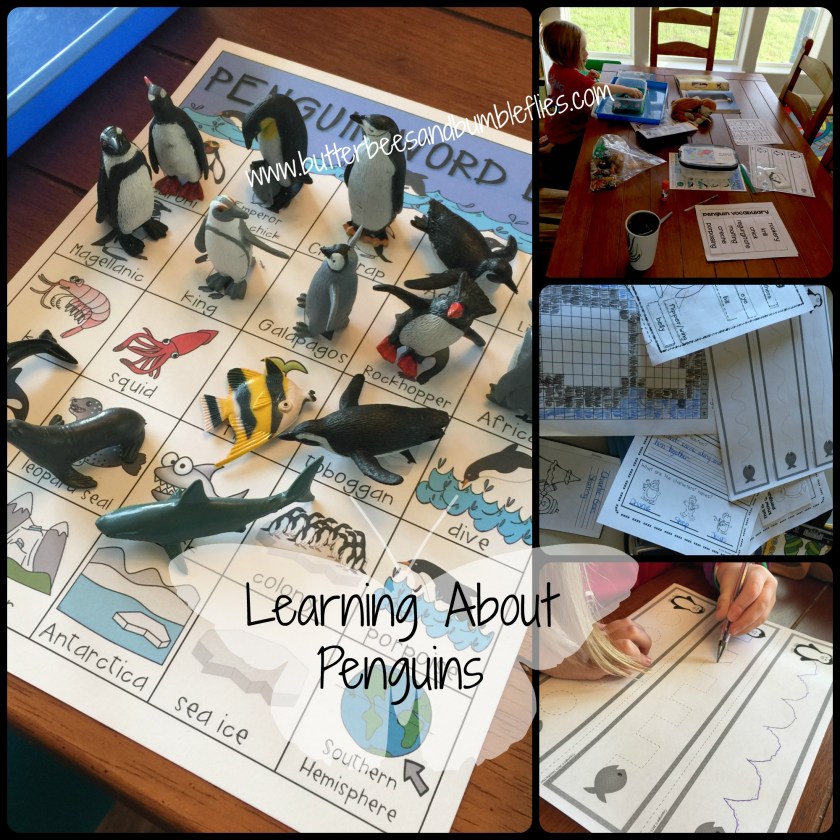
learning about penguins

So the past couple of weeks we have been learning about penguins.  I first told her we were going to make a mystery picture to find out what we were learning about.  Granted, this took a little bit longer than her attention span, but I kept it exciting for her by asking her which block to color next, and we traded off who colored and who read the letter/number combos, and who found the right block to color.  We got to a certain point on it, and the light bulb came on!  “We’re gonna learn about penguins!  Like in my Magic Treehouse Book Eve of the Emperor Penguin!” (aff link)  She was so excited she was literally jumping up and down in her chair.

We sat together (she often sits in my lap while we do school) and talked about all she already knew about penguins (which was actually a good deal) and then we both came up with some questions we wanted to answer about them.  I wrote down what she dictated to me on one of the graphic organizers, and then we talked about another way to organize our thoughts – with flaps.

graphic organizers

She really enjoyed the flaps, which I cut from one file and attached onto another.  (Hey, teaching is all about getting creative, right?)  All of the files I used will be linked in a list below.  All were found on teacherspayteachers.com as freebie files.  Later in our study, we talked about how we can also organize our thoughts into a web format.  She decided that for her, she prefers flaps as her method of thought organization.  She especially liked having the definitions of the penguin vocabulary words behind a flap, so that she could easily just flip and see the one she wanted to see.

coming soon

You might have seen this picture if you follow my page on Facebook.  This was one of her favorite parts of the unit of study.  I modified her old Antarctic Habitat Box to be just rock salt and white rice (less messy), and she not only got to have free play time with the penguins and their blue activity tray (aka water), but she also used the penguins (want to get your own set? Click here – aff link) and her penguin word bank sheet to sort and classify them.  We pulled a few prey and predators from our ocean habitat box as well.  She enjoyed acting out the food chain in her habitat, pretending the penguin ate a fish, and then a leopard seal ate the penguin.  Morbid?  No.  Not at all.  She is fully immersed in how the animal kingdom functions.

penguin reference guide

Then, we took all of the worksheets we completed and compiled them into a book.  She drew her version of a penguin on white card stock paper for the cover, and I even stapled onto the back cover her story book that she dictated to me.  Not only does it serve as a mini-portfolio of her work, it’s also a great reference guide for her in the future.  She is so proud to have it on her bookshelf in her room.  (And she took it to Mother’s Day Out to show her teacher and coordinator!)  We also wrote on the back cover the title and author of the two reference books we used (Penguins by Emily Bone, and Nat Geo Kids Reader – Penguins aff link).  We also listed the YouTube video we watched to learn more about a crèche, and the fabulous online resource of the New England Aquarium, where we saw amazing penguin pictures (we found them when searching for “molting”) and learned more about penguins in captivity.  It was important to me that she start learning the importance of sighting her references when she does research.  We didn’t go into formal sighting rules, just listed them so they are credited and we could go back to them in the future.

And now, to give more credit where credit is due, here are the links to the files that I used from TPT.  Again, they were all freebies, so I can share them with you, but please realize that these are NOT my creations – each creator has a page within the file that gives her credit for her work.  And each of these files is WONDERFUL!  I’m so thankful for a resource like TPT to find fabulous content for our projects!

Penguin Mystery Picture Graph

Penguin Word Bank 

All About Penguins

Flip Flap Fun

Penguin Pre-Writing Fun

Did you like this post or find it helpful?  Please comment and feel free to share on social media!  I’d love to see how you’ve used these ideas to help your own students!  Follow my Facebook page here.  Check me out on Pinterest here.  And now also on Instagram!

Homemade Gift Idea

So you’re looking for something quick and easy to throw together this week as a gift from the kids to mom… or for grandmom.  Or maybe your next door neighbor went above and beyond and now you feel obligated to return the gifting…

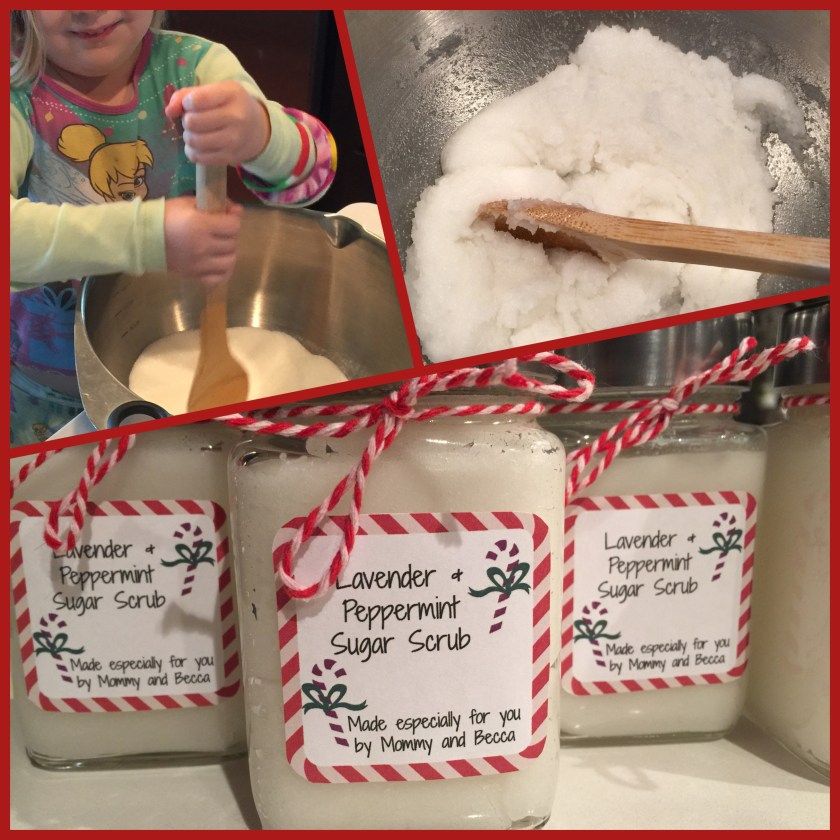
This is super easy, and you may have the supplies in your house already!  To give all the credit where credit is due, I’m linking HERE over to the original post where I got the recipe – you can get the recipe from her. 🙂

Processed with MOLDIV

If you like my jars, I found them at my local Hobby Lobby for $1.99 each.
One note I will make from the original poster – her recipe was not enough to fill one of my jars – we made a double recipe to begin with, and it filled a jar and a half.  So go into this with an open mind about how much coconut oil you’re going to need.  We got blessed/lucky/whatever and had the exact amount of coconut oil to make the four jars we needed for gifts, but when you’re shopping/prepping supplies, just make sure you have plenty of coconut oil.

Another tip for the coconut oil – if it’s too cold it’ll be hard to scoop from the jar, so you can zap it in the microwave for 15-20 seconds to loosen it up a tad.

And to make it easier to put into the jars without making a mess, I used my medium size cookie scoop (from Pampered Chef), which fit easily inside the mouth of the jar so I could drop the scrub directly into the bottom of the jar without getting it everywhere.

Becca loved stirring, and doing the math to help me double the recipe.  She helped me count the drops of essential oils to add in, and got more than a tad frustrated with me when we got an extra drop of lavender in at one point. 😉  She sat with me as I got on the computer and designed the labels, and she helped type the words “Mommy” and “Becca”.

All in all, this gets recorded in the books as a super easy, wonderful gift idea that we’ll be repeating in the future!  I’m looking forward to trying some other oils as well, to make different scents.

Side note, as I’m always trying to raise awareness for hidden disabilities – Becca has anosmia (the lack of sense of smell), so I told her this smells really good – what did she think it would smell like?  She decided that if it smelled good, it must smell like peanut butter.  Because peanut butter is her favorite creamy thing, and this is creamy.  The glow on her face as she told me what she imagined it smelled like transported me to a different world.  She’ll never know what lavender and peppermint smell like.  But in her mind, she has happy things she can equate to various things, and the beauty of her disability is that everything smells pleasant in her mind.  She’ll never dread the smell of a skunk, or wrinkle her nose as she carries out the trash.  Blissful ignorance.  It’s hard for me as her mom to see the positives in this disability, but seeing her smile today as she said it smelled like peanut butter… made me smile, too.  Because I know she’s happy with her imagination.  Never take for granted the abilities you have – someone, somewhere in the world, can’t do what you can do.

Create Your Own… Recycled Christmas Tree

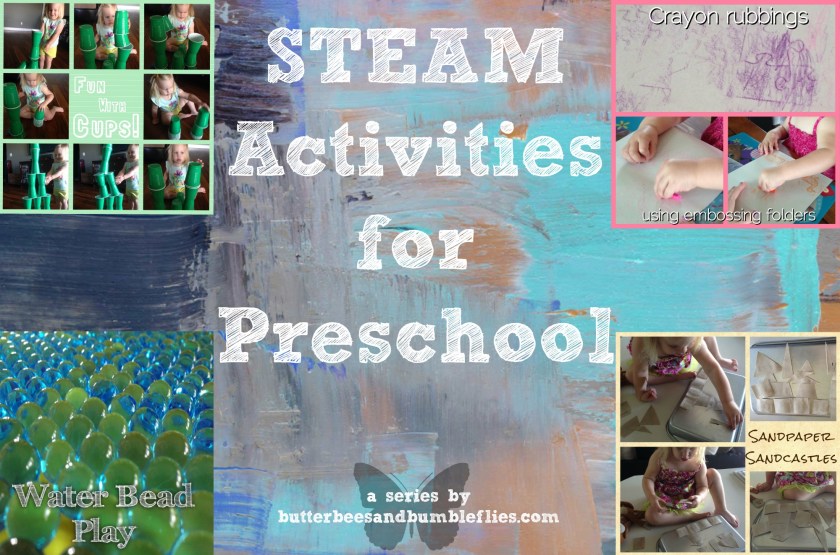
steam activities header

Looking for a super fun, EASY, throw-it-together-in-two-minutes project for your kids that involves STEAM?  Check out this fun little engineering activity I did with Becca this morning!  She had to miss “school” (Mother’s Day Out) today because we are all sick, but I promised her something fun.  She agreed that this project delivered on that promise.  And seriously, ya’ll… it was SUPER easy.

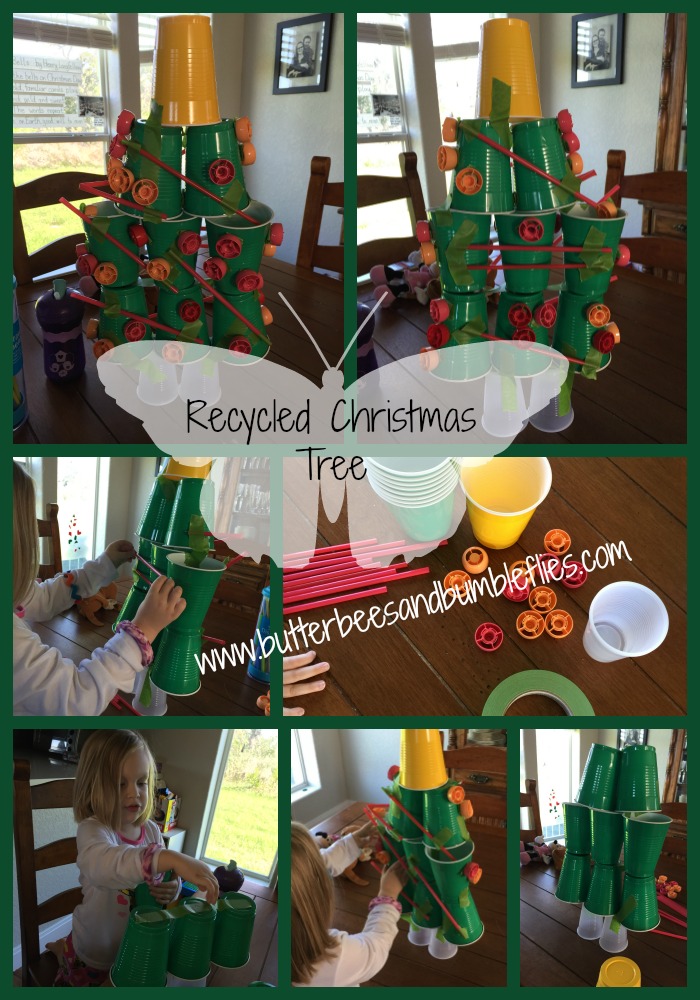
recycled christmas tree

All you’ll need are some cups (any kind of cups would work, but we happened to have green and yellow solo cups, so we had a green tree with a yellow star on top!), some straws, some fruit pouch lids (or any sort of recycled lids you can use), and some masking tape!  Our lovely Christmas tree is now in our foyer on our entry table next to our nativity set – she said we should put it there so Baby Jesus could see it.

This project was great for her problem solving skills – we had to use a lot of tape to make sure the cups wouldn’t fall, and she was upset that our first design didn’t look much like a tree, so we re-built it and she was much more satisfied with it’s shape the second time.  We spent about twenty minutes working on this together.  It was the perfect easy time killer, and lots of giggles were included!  She can’t wait for Daddy to get home from work so she can show him our “masterpiece!”

Looking for more Christmas activity ideas?  Check out my post here for little “busy bag” activities you can put together to keep even your toddlers busy!

Looking for more STEAM and Engineering activity ideas?  Check out my STEAM and Engineering pages!